Activism is increasingly instrumental, meaning it’s a form of power that is tied to the logic and algorithm of the status quo. This makes activism, even in the search for justice, a creature of the status quo, which renders hope and justice, as ironic as that sounds, a creature of the things we’re trying to leave behind.
— Dr. Bayo Akomolafe on Slowing Down in Urgent Times
it awoke me from sleep, the thought. A correction. something that clarified the feeling of not wanting to forgive, or not being able to. it’s trite, but three had always been my breaking point in this series of incursions, especially in those cases when there has been a latitude of attempted understanding and reasoning in between. the recipient of the gaslight, on the other hand does not calculate. how much is enough? the arbitrariness of numbers is probably less reasonable than the process of enduring or the tenacity of tolerating or the act of forgiving. actually on a certain level, it would be unreasonable——no?——to say to a friendship, to love, that i do not accept this anymore. right? W says there is no reason to 絕交 and we need time to learn and understand one another. of course. but what if i say simply that i am unable to continue like this? i do not like to count, but something keeps ticking. was it that which woke me from sleep?
perhaps it was the sudden clarity of watching an awkward transpiring of a series of very reasonable utterances of ‘not quite loyal’ words. the crispy field recordings of an anthropocene, brown noise wilderness that had kept me unconscious before came back again through the reverse journey from sleep into a dream-like scenario. i am in the post-apocalyptic game which we had romanced together last summer. so i am alone, but reflecting upon relationships that are perhaps no longer possible, and there is something forlorn and undone about this, though that’s what apocalypse is really. it’s drizzling and murky here all the time, here and there, we woke into dream and reality is simply a matter of perspective. it’s exactly that we argued about this, a simple difference of experience about something that happened in the past. you brought it up because you were hurt and disappointed, but what is meant by ‘not quite loyal’ is that hurt is prickly and dishonest if it only cowers behind rage. it’s reasonable, yes, like when i reason with myself that forgiveness is a higher ground. i’ve still never gotten there, still on game one(放下,不是放棄,而不是失去), too short of an attention span for mantras.
how does she keep forgiving? it’s a questionably positive character trait these times around, a puzzle to play on both sides, like when S describes M’s bad quality of not being able to see anything negative of anyone else. I thought when she said it, oh, how strange that is! What’s so wrong with roses? But anyway, I am not M nor your ex-girlfriend, not so forgiving and not so resilient, maybe not so tolerant, not so enduring. i don’t want to calculate, but don’t know how to bear the unfair exchange of a wound for a blow, even if understand how I may be implicated in its opening. I am sorry, even, that I said something awkward and ambivalent when we played the game that time, but wasn’t it obvious that we were in the grey and murky chapter where awkward and ambivalent things are uttered? Is being sad and disappointed a violence already inflicted, with reasonably violent returns? That is the ambivalence of saying stupid things that you realise are stupid in the midst of voicing them, but there they are, your mouth is open, stupidity lays before you just as the person in front of you, the one who receives it while listening with an unwittingly ever so slightly peaked (piqued?) eyebrow. The person in front of you doesn’t say anything in this moment, of course——that’s what ambivalence does; it delays time in the staccato of its complexly unfurling hesitations, though the simultaneous folding in and folding over of affect leads to other arhythmic utterances for which connections are astray and hence may also be categorised as stupid. ‘retarded’ is a politically incorrect term these days, but it is exactly about the mismeasure of time rather than being wrong or right per se. Ambivalence is fair. Its slowness is an emphasis upon space rather than its surrounding points and prickles.
justice requires calculation. but i’m no heroine, and it’s always a bit more complicated than that.
Posted by 丫 | reply »「尋找問候」,第五章(wish you were here no. 5)
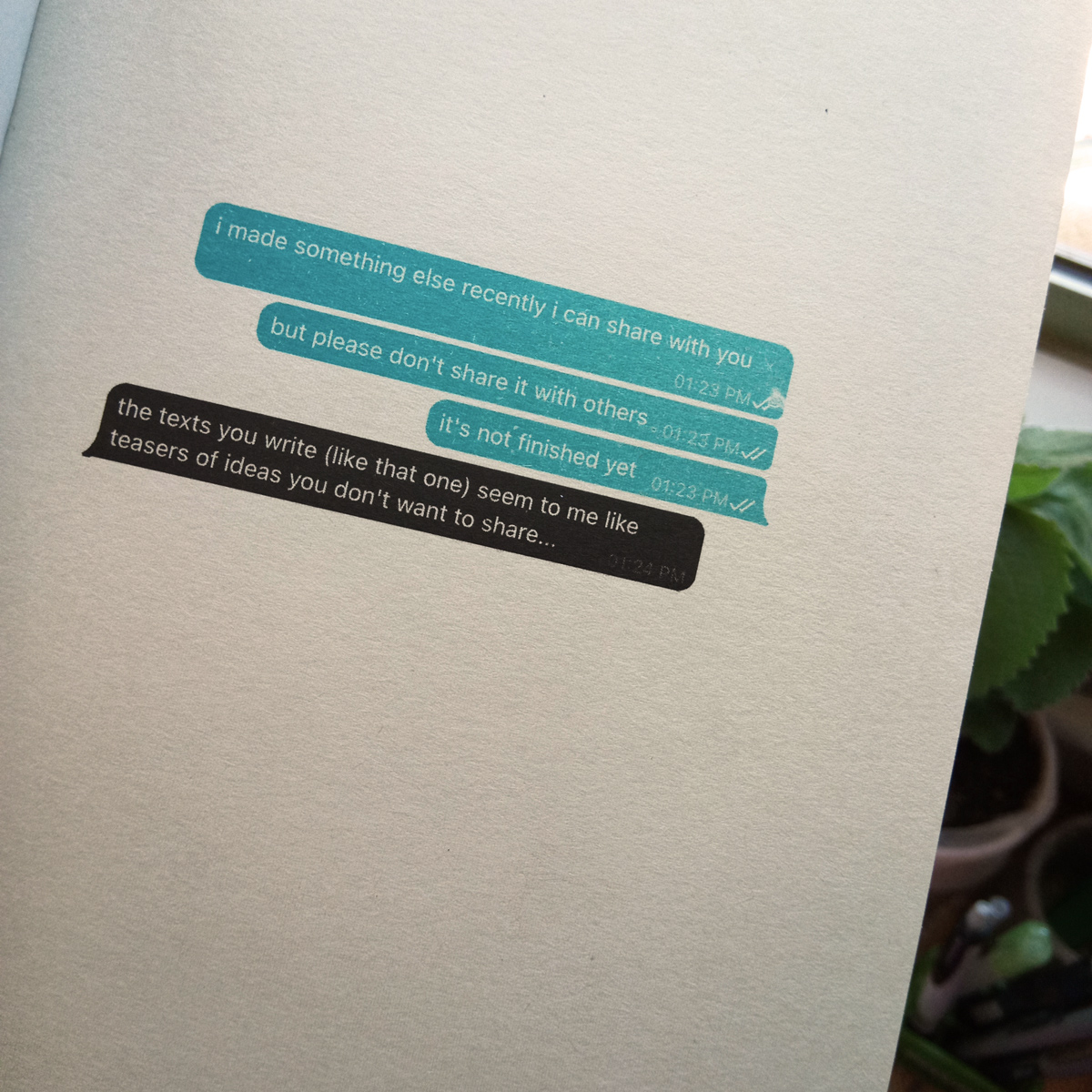 the first page of Resident, or Resident Evil, or This Minor Contextualisation of a Minor Temporality Known as Publishing on the Run, self-published 2022 (the copy for boat is the only time a delivery has completely failed)
dear h.,
the first disclaimer is that this letter is possibly not to only be read by you. i can imagine you might find some offense to that, but i realised like some strange twitch in me, there is something making me unable to face up to certain individuals on the ‘should reply to’ list, kind of like being less able to look at people in the eyes. and if i could only make this happen through finding a channel through a more general, faceless you to you, then it may only be this for the time being. looking aside from your eyes, there is a thing next to the thing. but it must be next to you.
i hope you may not be too offended and can find a way to understand this possibly strange manner of behaviour, perhaps a bit of a narcissistic reverse to the original request to hear more about you. i think most of what i saw and wrote before were also self-projections, which despite their reassurances makes me feel worse somehow, like not being able to look a you in the eye. that is why i said i will try to ‘face’, another way.
i ran into our mutual acquaintance Y last weekend and——in the same vocal paragraph of bemoaning the fact that people don’t read anymore——she was adamantly encouraging about continuing to write. so i try to readdress.
the last message you wrote was that _Friends are important. Especially nice if one doesn’t need to socialize to have them_ And it has almost come to this stage in life where one can say exactly that, like wise (and funny) C. noted so so long ago about knowing a good relationship when you can sit together in the same room together and feel comfortable not speaking to one another. more recently, W. discovered a version of it in the form of a named therapy called ‘body doubling‘, which is a less romantic, more production-oriented way of thinking about being together in a world that is absolutely not ‘together with it’. That goes back to the difficulties of being sad-core in a success-driven society, though one may also argue that success-driving is exactly what makes the fissures with sadness ever irreconcilable.
so go back to rhythm. 4/4 time is simply 4/4 time, but one can be-come another, there must be infinite transitions from the one to the other, right? Is this a silly metaphor? What makes you laugh these days, if you are still thinking about the point of humour? I actually really love your laugh. It’s more like a giggle or a chuckle, because you are generally a quiet person, and that is endearing coming from a man, if i can say that. An array of subtleties there, but maybe (another projection here) that combination of cynicism with humour is where our rapport found its place. i think i would define absurdity in such a way, but hope we can find some sort of specificity here that extends it beyond the nationalised version of which you spoke? Or maybe you’re right, as we are mostly so well trained now as ‘internet Americans’. That is the horrible contemporary universalism of language and humour buttressed by technology. Do you remember the very bad joke about Elaine and Coke that you shared with me when we first began talking more, from the ad campaign that was all over the city at the time? Something like that.
Another thought. That you can continue with the small joy you take from the live shows. Small joys is the same thought as rhythm, i think. So how to maintain the rhythm in which you can keep returning to that? Because of course it is so hard to see what small joy is in the midst of a dark refrain, or in the outburst of anger. I try my best not to react these days. Writing to you in this way is perhaps the same gesture of self-reflection while feeling terrible. So yes, I don’t know how to think too much about Kassel because it bore, in some ways, that feeling of rift. The core and the face alienated from one another in this overdramatisation of camaraderie that I wanted to partake in, but could only flitter about numbly because most of the things that were causing internal distress had nothing to do with the context at hand. Looking back now, perhaps I could have made better links between the core space and the extension of limbs. I don’t know how that would have been possible. I tried the direct confession to the best of my ability. I apologised. And still, I lost a friend. Too many accumulations of ‘created absence’ these years. That echo of emptiness is probably what rings this tinnitus.
About you at that time, I only felt that you were eager for having a real dialogue, which I would have wanted to do but can never do in those social situations because I want to try to take care of everyone——a mise en scène——only to end up failing mostly myself, of course. I didn’t feel anything destructive on your part, only that you were unable to read this from me and the situation, leading to your feeling of disappointment? what did you feel was destructive? were you upset?
i think you know yourself well enough to make choices that work fine for you given circumstances, but perhaps it is also about learning to rely more upon what we don’t know about ourselves, or about others… I wonder if Brasil was able to do that for you? You didn’t say too much about it. Someone said to me once that when he was young, he used to think that he was right, that it was the whole fucking world that had gotten it all wrong. But the older he became, things turned, and maybe it was that the rest of the world had it right, and he was the one who couldn’t figure it out. Years later, a young friend said with a grin to me that he hopes to keep finding himself wrong, because it’s when he feels that he’s more ‘right’ than everyone else that he’ll know he’s gotten too old. are you an old man yet, dear h?
Shall we meet (online) soon? Do you have non-socialising, body-doubling friends where you are now? Is it important for you to bring bodies and friend(s) and ideas and trust together into one room, and how do you go about doing that?
from another city,
e[UTF-8]
     ::   ,,,,,,,,,       ::         ,,,,,,,,,,,,,,,,     ,,,,,,,,       ,,
     ::    ''' ,;'       ;;,,,,,,          ,::'           ::    ::      ::::
'''';;'';;    ;;        ;;     ;;        ,;'::';,         ::''''::      ::::
  .;;' ;;' '''::'''    ;'     ;;       ,;'  ::  ';,       ::,,,,::      ::::
   ;; ;;'     ::            ,;;      ;''    ::    ';,     ::    ::       ::
    ;;;'      ::          ,;'';,            ::            '';:::''       ::
   ,;;;,     ,::        ,;'    ';           ::             ,;';;    ,    ,,
.,;''  ';;.   ;;     .;;'        ';,.       :;         .,;;'   '';;;;   ';;'

  ,,,;''  :: ;,     ,;',,,,, ,,,,,    ::      ,,              ,,          ,;,
 '''::    ::  '   ,::' :: ;: :: ::    ::      ;;          ,,,,;;,,,,      :::
,,,,;;,,,,;;,,,, ;;':: ::,:: ::,::   ,::', '''::'''::         ::          :::
    ::    ::        :: :: :: :: :: ;;':: ''   ::   ::   ,,,,,,;;,,,,,,    :::
    ::,;  :: ,;     :: ::''' '''::    :: ''''';;'''''''    ,, ::          :::
 .,;::'    :;;'     :: ::       ::    ::     ,:;,          :;,::''''       :
 '  ::   ,;;:. .    :: ::       ::    ::    ,;' ';,       ;;'';;,          .
   ';;  '   ``;'    ;; ::      ';;    ::.,;;'     ';;,. .;;    ''';;;,,.. ';'
sometimes the fires cannot be fought,
in which case, you can also e-mail me at ho【愛特】iwishicoulddescribeittoyoubetter【點】net.
何穎雅 now in new territories.
上海かえるダイアリー
//2022年11月23日、東京。Art Center Ongoingで「かえれないわたしたち」という無断企画展を勝手にやったばかりなのに、パパの体調のことで、急遽、12月のまだ高いエアチケットを買わなければならなくなったのです。帰れない私はまる3年ぶりに上海に帰ることになりました。なかなかドラマチックだよね。自分はよく「中国」という言葉を避け、「上海」と言うことを好んでいることに気づきました。
//2022年11月30日、東京。出発までカウントダウンの1週間。上海の烏魯木齊中路で白い紙を手にした人たちによって「白紙革命」と呼ばれる、これまでにないデモが発生しました。それは偶然にも、私の上海の自宅の前の路でした。ネガティブなニュースを読みすぎたので、パソコンからすべてのデータを削除しました。 また、もう1台クリーンなスマホを用意しました。 実際に使っているスマホを持っていくかどうか、非常に迷っていた。規制の基準が曖昧なので不安かな。
//2022年12月7日、浙江。入国の深夜、中国政府は「これからPCRはもうしない、ロックダウンもしない」と発表した。3年の「ゼロコロナ」政策は急に終わったのか?後で自分の失敗に気づいた。上海より安いチケットのために浙江省から入国したこと。そこは私の実家です。 親と、過去とつながっている場所です。隔離ホテルに向かうバスは、深夜の高速道路を疾走し、まるでブラインドボックスのようにどこに行くのかわからない。バスは消灯し、乗客は眠っているように静かだった。暗闇に残された光は、スマホの画面の光だけだった。急速に後退する冬の夜の木々を結露した窓から眺めていた。私はこういう冬の深夜バスに乗る感覚をよく知っている。
//2022年12月11日、浙江、隔離ホテル。隔離されたホテルの部屋には、青いプラスチックの四角いスツールだけが置かれている。 よく見ると、その上に花の模様がある。 ネットで鉛筆と白い紙を買って、フロッタージュでこの模様を保存した。窓の外に山がある。八日間山を見た。それが親しみと喜びをもたらした。久ひぶり!ここの空気の湿度、空の色、食べ物のにおい、方言、人の雰囲気(オンラインだけど)を感じるんです。 電話からママのアンハッピーリアクション、ママと私のそれぞれのエモーションを感じるんです。コントロールフリークママと弱くてパラノイアパパはいつも正反対な意見で、私は葛藤を抱えた娘に成長しました。集団主義、あるいは上からの強力な未知の力。いろいろな突然の不可解な力によって、少女時代に戻されたような気がします。RUN AWAY GIRLだったね。この3年間ママと会えなくて会いたかった。もうママとの関係は治ったと思っていたけど、オンラインコミュニケーションのフィルターがかかっていたかな。リアルはどうかな?ママとの関係も多分中国との関係に似てる感じ。あーあ、ママ、愛してるよ。愛してるけど、怖い。ネガティブで弱い心を見せてしまい、申し訳ないです。浙江省に戻ることは、少女時代に戻ることです。
//2022年12月15日、浙江、隔離ホテル。検疫期間がもうすぐ終わる頃、隔離ホテルの6階の部屋の窓から向かいのバス停に手を振ると、ようやくパパが私を見て手を振り返し、またスマホを掲げて写真を撮った。 でも、ママはどこに行ったの?数分後、wechatグループに私が手を振っている写真が届いた。パパはもういなかった。 少ししてママが現れて、ママも手を振り始め、私はもう一回手を振らなきゃいけない。必然的にちょっとしたパフォーマンス感があるね。ママも写真やビデオを撮って、私もまた撮りました。
//2022年12月16日、浙江、実家。この国のすべてが正面から襲いかかり、私を包み込んだ。言葉遣い、声のトーン、思考の癖、目線、動作、すべてです。 反対するものも、実は自分の身体の中にずっといた。
//2022年12月17日、浙江、実家。でも、困難は欲望を増大させる。
//2022年12月20日、浙江、実家。ここでの人間関係のほとんどは、実家のある団地のグリーンベルトにある剪定されていない木のようなものです。高すぎてすでに未開の森のように荒々しく、絡み合い、空を覆ってしまっている。「柔らかい柳の枝に風が吹くように」、何度も何度も彼女の言葉を思い浮かべるが。
//2022年12月22日、上海、冬至。ようやく上海に戻る時、バスの中は運転手と私ともう一人の乗客だけになっていた。近所をちょっと散歩した。この路ですよ。烏魯木齊中路。友達が「もう革命聖地になったよ」と冗談で言った。アメリカ大使館、イラン大使館、フランス大使館もある路。人を制限するブリキ壁がまだあるんだ。なかなか崩れないね。交差点ごとにパトカーや警察官がいて、私服の刑事の方が多いかもしれない。警察官は、たくさんの時間頭を下げて、スマホで遊んでいる。かつてはいろいろな人や文化がミックスしていた面白いこの路は、ここ数年でインスタ映えする路となり、あらゆる種類のトレンディなカフェやアイスクリーム店がひしめき合っていた。今は落ち込んでみたい、戦後の雰囲気すら漂っています。 そんな見知らぬ上海でも、私の大切なバッファゾーンであることに変わりはない。クリスマス前に上海に戻った最初の1週間は、知り合いも知らない人もみんな陽性になちゃってた。
//2022年12月24日、上海、クリスマスイブ。政府が強制的に接収した郊外の工場棟にあるシェアアトリエの引っ越し。 過去のたくさんのもの、カビがついてる作品も捨てた。鍵の山。ドアがどこかわからない。対象のないキー。対象のないパスワード。
//2022年12月28日、上海。実際に中国に入国してみたら怖がる必要はまったくないのです。出発前の恐怖は想像していた恐怖だね。想像していたけど、同じくらいリアルで恐ろしいものだった。自分の弱さを思い知らされた。今思ったら、今までの「正義」な私は、ロマンチックすぎて、自己感動的な偽善だったじゃないのか?用事の合間にちょっと シェアサイクルしたら、久しぶりにシンプルな喜びを感じることができました。
//2022年12月29日、上海。心理的な帰属意識と物理的な帰属意識、どちらが真実なのでしょうか?複数の目的が混在しており、目的が不明確である。 彼女は病気のパパに会いに来るため? 家族を訪ねるため? ママとの現実の関係を確認するため? 思いがけず移住の心理的問題を解決するため? アトリエの引っ越しのため?荷物の整理と発送のため? 上海の映画館で中国語字幕付きのフランス映画を見るため? 好きな美術館で、見たい展覧会を見るため? 友人と再会するため? 銀行カードや運転免許証など、特定の事柄に対処するため? 何年も会っていない元カレたちに会いに行くのか、行かないのか?結婚した私の顔を見せるため?
//2022年12月31日、上海。2022年最後の日、突然、彼女のアパートの鉄門扉が倒れた。彼女は布団の中で泣いていた。泣くことは奨励されない。悪い状況でも、人は良い面を見せる傾向がありますね。昔行った映画館に行った。昔行ったレストランで食事をした。昔の友人や恋人に会った。昔ようにネットショッピングをした。昔の習慣やディテールなどを真似ることは、過去とのつながりを再構築しようとすることです。過去へ。でも失敗。モノや環境が過去の情景や感情を運んでくれるけど。何故だろう。人は自分の過去とどう向き合うのか?
//2023年1月1日、上海、元日。ハッピニューイェー!ハッピニューイェーか? まあ、とにかく、いよいよ新年がやってきました。烏魯木齊中路が突然、オシャレな男女の群れで活気づいた。それから10日後慌てて上海を出るまでずっと、このまちが急に活気を取り戻したようにすごく感じた。都市のエネルギーやっぱり!そして、前のいろいろあったことが跡形もなくなったみたい。すべては起こり、すべては忘れ去られた。
上海に帰るまで切らないと決めた長い髪は、結局上海で切らなかった。上海に帰ってみたら、あの3年間の長さは東京のものだったんだと分かりました。
Posted by boat | more »without cringing 2022 screenshots of january and june
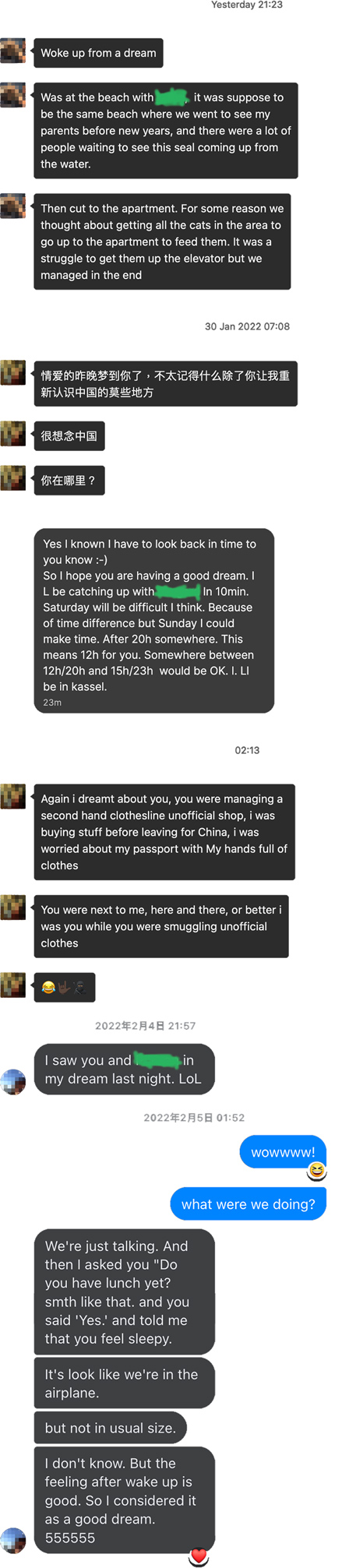

小船 Boat
With the exception of one fateful date, the four other exercises that I designed for Visual Diary Archive were each put together with a specific person in mind. I don’t speak to any of them so often anymore, and with distances, it sometimes becomes difficult to know where and how to begin again. Words don’t always bridge gaps, and perhaps neither do images, but if a series of exercises incite certain actions, I wonder what new thoughts, imaginations or understandings may be filled in the spaces between us.
The other quandary or surprise this brings us is the question of participation. It was because of a lack of general participation that I decided to ask a single person to respond to the exercises for me, and since each exercise had also been addressed to a singularity, it somehow made sense for this text-based response to be as well. So this is for Boat——less far, but also some distance away. I thought we would be connected by the expanse of sea next to our cities, but after checking the map I realised that the water where you are has a different name than the water where I am, even if water is fluid and I don’t want to believe it has bounds.
…
Nina and Asako made a work together in 2014 called The soup of a body past: notes on evaporation. Here is an image of the text that was printed and hung in the space:
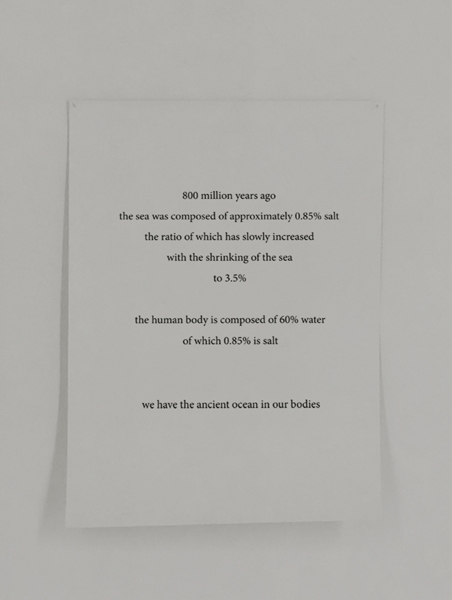
And so I think now, along with Fotini and pictures of words, of the similarity between water and thoughts flowing between us, like ancient salts that both wound and heal us over time. Do you know the English idiom about rubbing salt into someone’s wounds? It means to make a bad situation worse, to aggravate it.
When we talked recently about togetherness, about how to participate in a project about being together, it felt almost like salt, like our non-togetherness being amplified by discussing it, and after that long back-and-forth of messages, I cried, alone. It felt bad, but maybe like the tolerance for salt, alcohol, and drugs, resilience grows with experience, so I really cannot say it was an overly aggravated situation. Unlike the connoisseur, after all this time I would prefer to make less judgements about who and what are wrong or right or bad or good. But maybe we can keep searching for new words or images or thoughts to simply keep describing the taste of these things. Like the quandary or surprise of your participation, I want to meet something outside of myself and get to know it better.
What I mean is, if it was a less than ideal situation that hardly a soul volunteered their images or words to this project, maybe it was kind of salty to finally see your contributions——several being what I saw as misunderstandings of the instructions. I think anyone who has asked anything of anyone else will know this taste. Let’s call it the strange flavour of ‘participation’ or ‘getting others to do things’, together or not. Sometimes it comes in the form of ‘collaboration’ (what Eyal Weizman calls the ‘very absolute extreme’ of participation), sometimes ‘coercion’ (what parents sometimes have to do to get their children’s compliance), and very often ‘compromise’ (what we as independent, less than star practitioners have to do within the systems that we would often rather confront). In this instance, there are two layers of participation: one requested from a general audience on the Internet; and secondly, the participation from you, which was performed as a favour to me. Both may be described as the kind of slightly disappointing or wounded salt of things not happening as were expected, but maybe I have to suck on this a bit more, to allow a passage of flavours to come through in engaging with that (non)participation. Something more like the 鹹梅 salty plums I used to love when I was a child——sour, sweet, bitter, savoury and salty.
So if I am to try to take in these five images you posted just a little bit longer, yes, some things made me squirm a little bit, or laugh, doubt, affirm, feel perplexed, and/or smile. The date 2020-06-30 got replaced by a longing for Shanghai about one year earlier, and it felt at first like a betrayal to all that 2020-06-30 means for Hong Kong. On the date of your photo, 2019-05-26, chosen for some other reason of which I am not aware, things had actually already begun boiling here. You, living next to waters with a different name, are not expected to have known that. And so your participation with rain in another city on another day defuses the centrality of importance, like maybe the way that rain probably was once a particle of air which was once part of an ocean with a wholly other name.
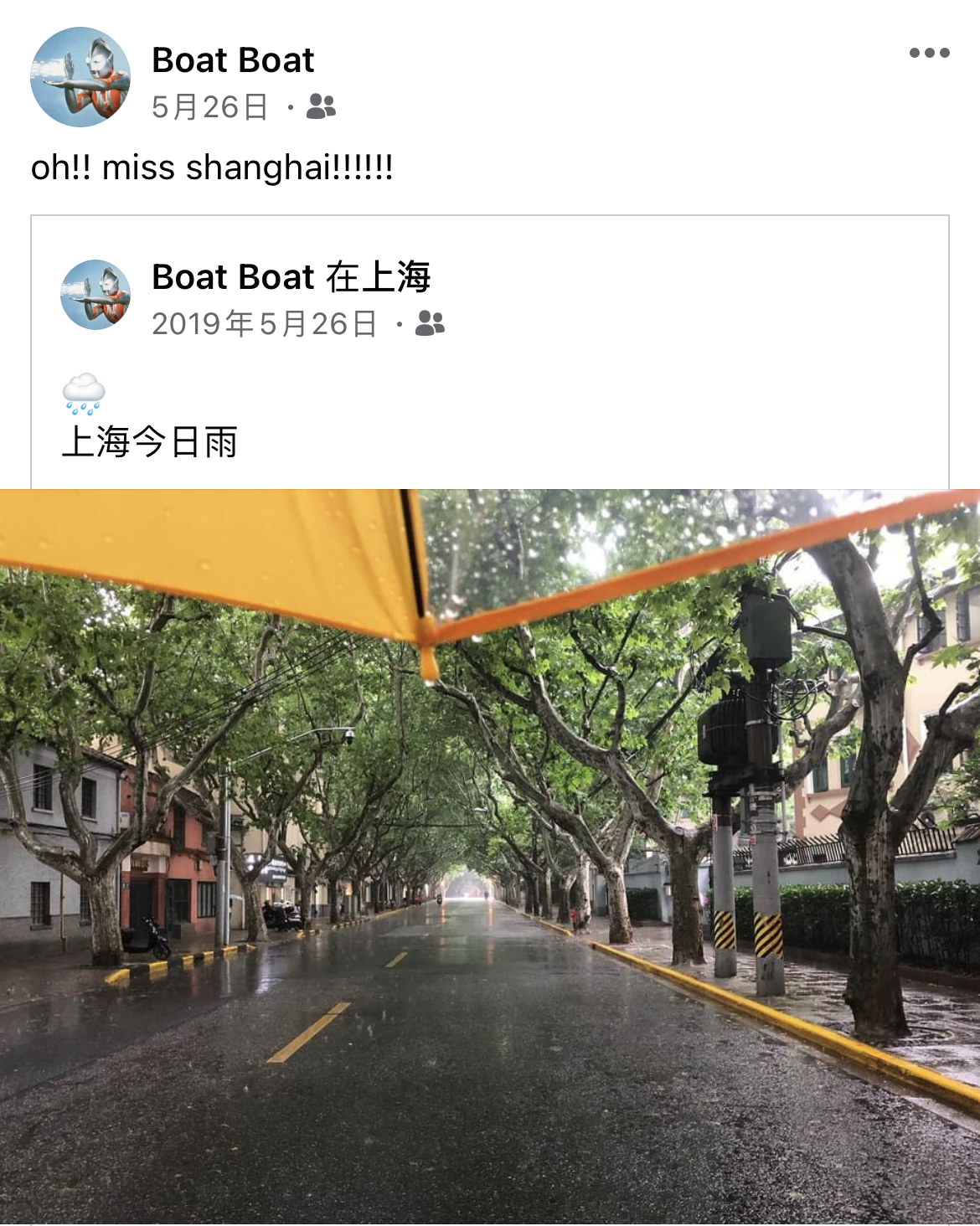 Submitted to Visual Diary Archive by 張小船 Boat Zhang for 2020-06-30
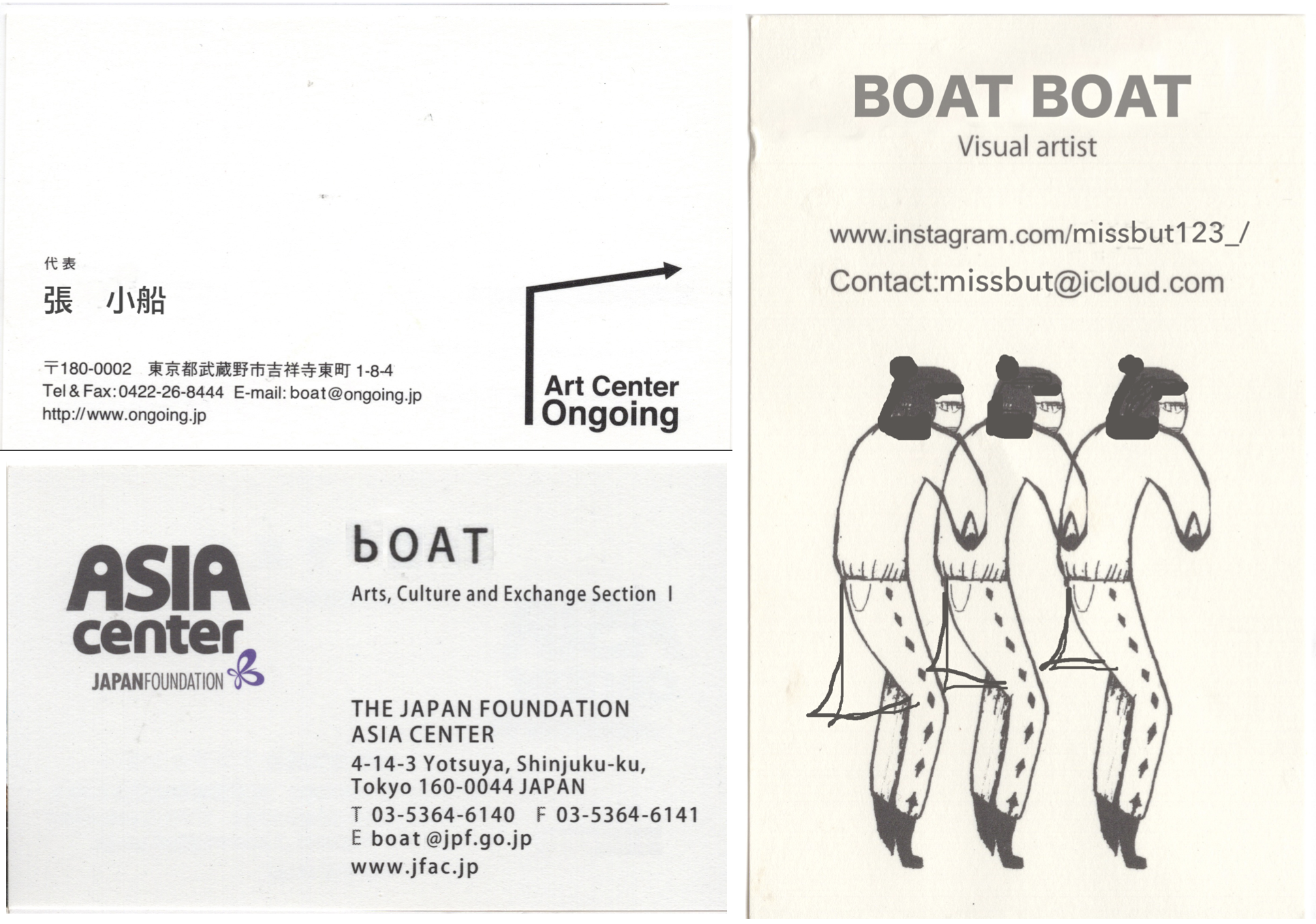 Submitted to Visual Diary Archive by 張小船 Boat Zhang for Fotini
But you want us to know your name. 張小船, big B – big O – big A – big T (x2), little b – big O – big A – big T. I had initially imagined the Fotini exercise to locate searches for meaning, like when we take photos of pages from books to replace taking notes, or record signs as a way of remembering. You’ve shared yourself with us here, in a few guises but you all the same, funnily captured in a print format that is mostly outdated, though it makes sense in the context of you living now in Japan and with what I had asked you before in an audio recording also dedicated to you. So yes, ‘a lot of Boat’——meaning, and a string of things to remember.
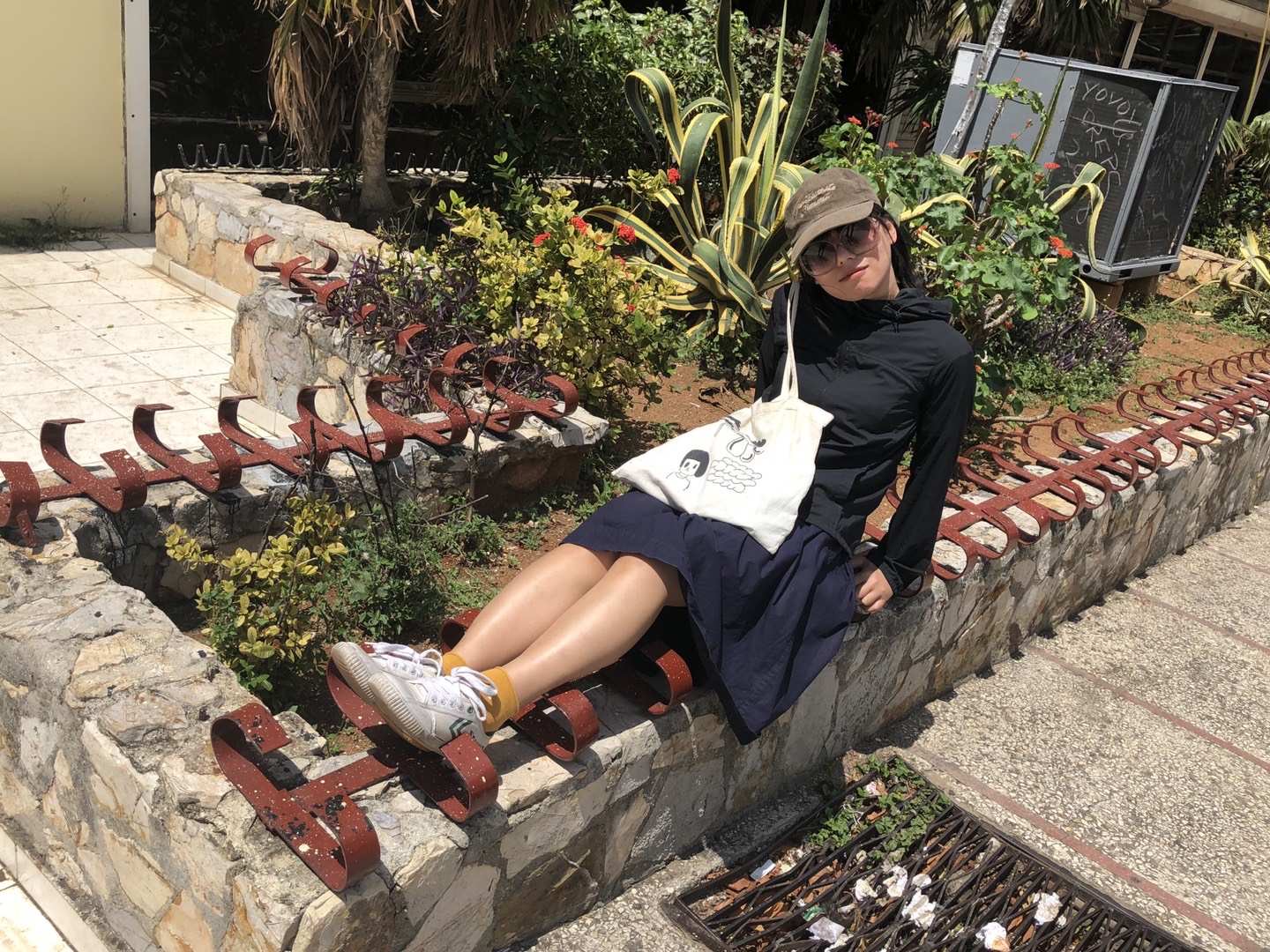 Submitted to Visual Diary Archive by 張小船 Boat Zhang for 京蘊 Anouchka
You appeared again with Anouchka, and it was so surprising to see you, ordinarily so shy, now leaning back in this very forthright position, looking at the camera confidently, even if hidden under a cap and sunglasses. Those metal bars must be the Cuban counter to the kind of structures they put in the parks and underpasses of Hong Kong——manmade objects to keep people from public spaces. No loitering, no sitting, no sleeping. But there you are, sitting defiantly on top of them, and though it must be quite uncomfortable, you reveal in the caption the immunity offered by being in the eye of a crush. Now he is crushed in prison and your small secret opened up in the maze of someone else’s archive.
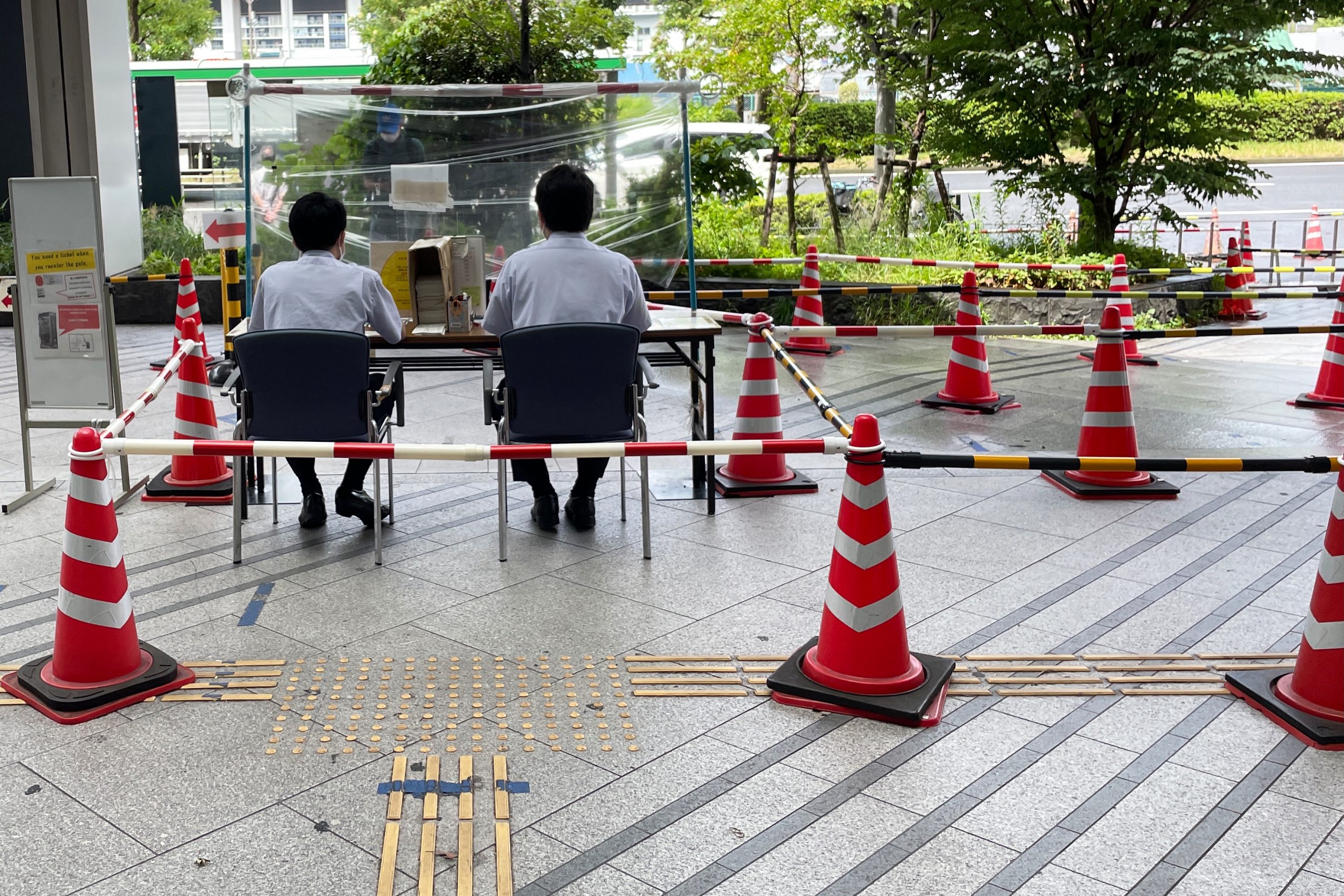 Submitted to Visual Diary Archive by 張小船 Boat Zhang for Nisan
Nisan would probably not be pleased that I’ve translated her idea for a continuous line among discrete objects in this way. So maybe it is fitting that your image leaves a very small gap in the line, which, if we were to put together with the other photos, would break the horizon. It’s not certain whether this subtle subversion on your part was purposeful or simply a visual opening of the ‘rules of participation’, but I’m glad it would be you to do it, just as I am thankful that it would be you to tell me during a long and painful back-and-forth all the horrible things that have gone astray and still be my friend.
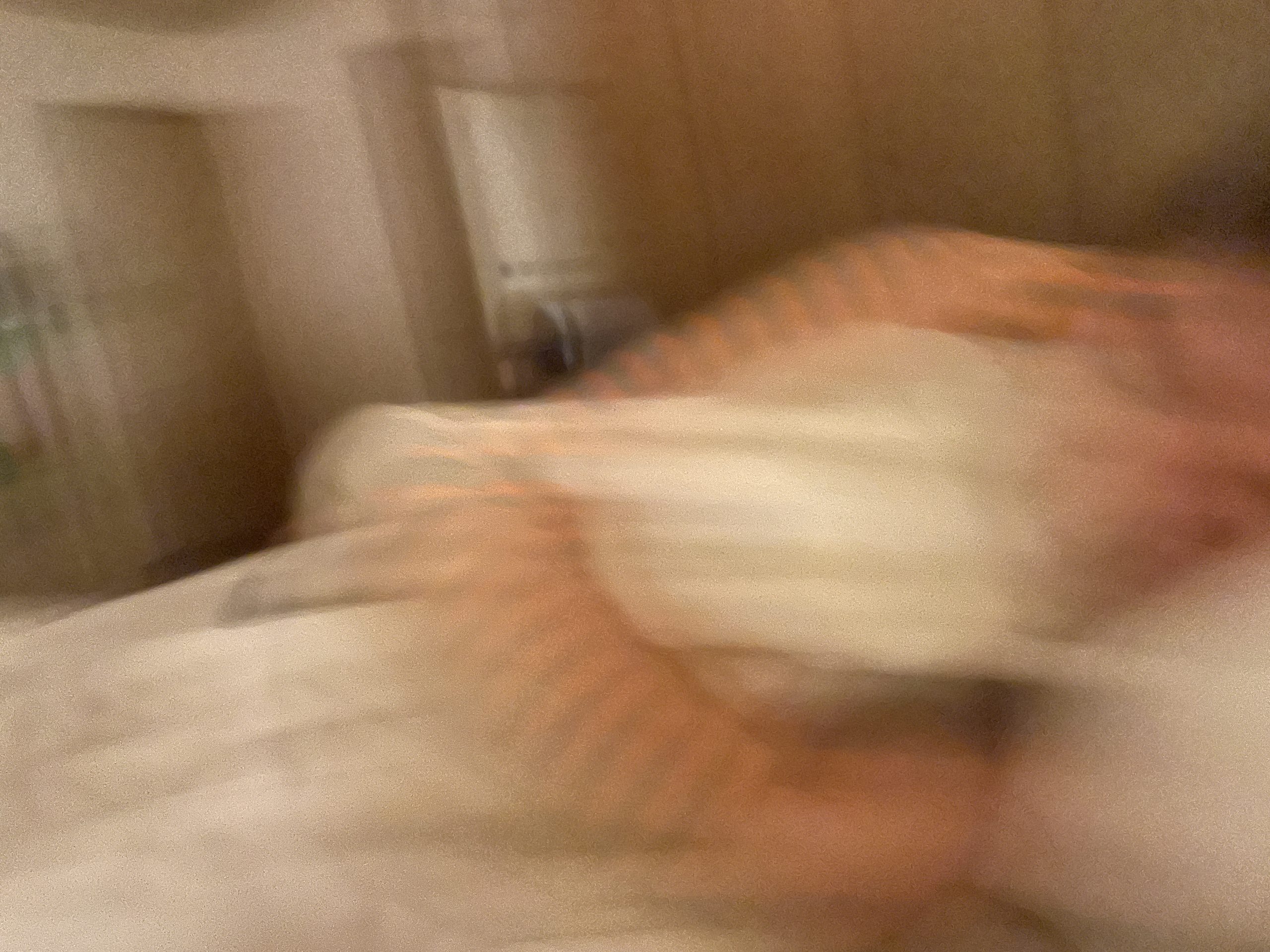 Submitted to Visual Diary Archive by 張小船 Boat Zhang for Nina
And maybe that’s why the last one, Nina, is the one to end on, because it’s another intimate space between you and a lover. This time you are the photographer, but for all the power within that role it is a sudden fear from the sudden movement of his sleeping body that clicked this shutter. And this is quite a complex story for a mistaken photograph——at least compared to the majority that I had collected and cannot place at all except by virtue of the photographs taken before and after. Your photo for Nina bears similar warm tones as the ones that she has collected in her archive, though hers are mostly created by the redness of light seeping through skin.
…
I want thousands of beads of sweat from my body to seep through my skin and slip into an ocean that has one name on one side and another name on another. Sometimes these oceans are named after people, while you, on the other side from here, are named after the vessel that keeps us afloat on the sea. It was the most cheeky and romantic of things for your parents to do, but like these images, what I like most are for these smallest of intimacies to be laid bare in a plain space for anyone to know and see, the most subtle invitation for participation. An act of taking notice.
And after those long hours of talking about ‘getting people to do things’, it is still difficult to come up with answers. But you contacted me tonight as I wrote this text, asking for a favour.
So for now——simply——yes, of course.
Posted by 丫 | reply »epistolary formations (for Ĵ, Ş, Ȼ and Ḅ)
dearest yous,
digital crumbs here in response to those things you said, those things you sent, real material ways and a digital means. ‘i am sorry for the delayed reply’ prefaces so many of these formations, followed mostly by the mental hesitation for apologising too much. though it’s nice to hear ‘no need to apologise’ in response sometimes, it takes a sorry to get there. truly sorry for too many things.
lateness somehow psychologically necessitated a more involved response, if this so-called ‘publicness’ can warrant any more meaningfulness. actually i told Ḅ that what i like most here is the anonymous intimacy of passerby in public, because being an outmoded place, it’s hidden in plain sight, Emily Dickinson style. there was a period when i wrote little notes and left them in random places, too, and i found one a few years ago that didn’t get distributed, so sent it to Ẳ in the post along with a bunch of other random things, but i think the clutter of it all overwhelmed her, so there was not much conversation about it afterwards. at the time, her son could just fit the quarter-sized sample jacket i made in fashion school.
so many things need explaining.

and your faith astounds me sometimes. but i guess we still make (it) work. it’s perhaps not so dissimilar——nudity in public, intimacies for those who were never keen at p.d.a., the weaning separation from one’s body that is called a work.
Art is insufficient to narrate the inhumanity of history, because it is insufficient to explain it. Disaster is either explained by means of psychology, or the savagery of society is described as if it were a supernatural event; fascism is presented ‘as the machination of rackets outside society, not as the coming-to-itself of society as such.’
-from The Orpheus Double Bind: What Can Writing Save?, Nurdan Gürbilek

and what would you say to those that don’t watch films, don’t really read books, don’t dance? aren’t they terrible, those people, how are you going to explain it to them? how are you going to wish for them the thing that changed you and you don’t regret it not one bit, except all the times you fail to explain it to your stern mother or that person in power that you wanted to impress. you’re sorry.
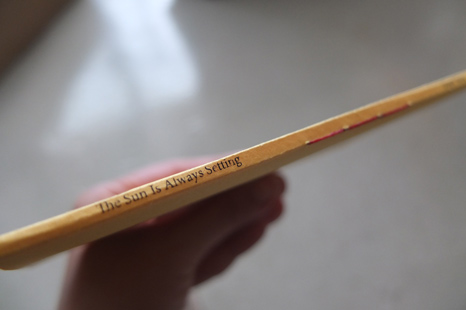
Ş, i like the digitised irony that your rooms reminded me of playing Hitchhiker’s Guide to the Galaxy, or growing up choosing my own adventure——though you don’t say ‘you’. but something like she says, it wasn’t birds but paper speaking——your real, material and actual post, Ş, so carefully bound by hand and sent to me across the Pacific just as you said you would, when most people don’t. and with that I have to tell you, unapologetically sorry, that I haven’t forgotten what I said I would send to you. it’s not ready yet, hopefully soon.
“Time the Great Healer (live at the Boston Museum of Fine Arts, 5 September 2006)”, Cat Power
though today i put off work to deal with a number of personal matters. and really that is an irony as well, as if they were separate in these realms, you know what i mean, but again it’s something about still learning to explain after all this time, i have to reiterate myself and you to yous again and again, because you weren’t listening and in my anger i don’t hear myself. maybe you’ll say i have to listen more in order to be heard. maybe.
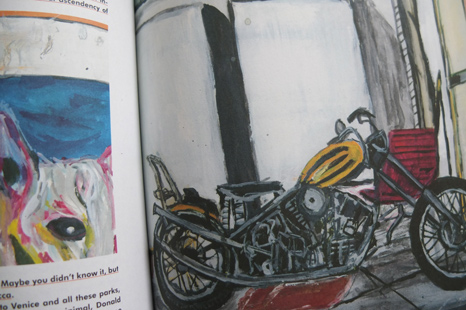
i like that the package from Ĵ, one of the most dedicated in believing the romance of ‘art’ and ‘post’ all these years, came this time not directly from you but by the smooth spaces of guanxi through the editorial office of a magazine based in Spain. i like that you once fleetingly included me in one issue, and still hope that we’ll have that chance for a two-day dialogue over sidewalk beers some day.
“ピンクブッチ Pink Butch (ラララ Lalala)”, マジカル・パワー・マコ Magical Power Mako
i like that an e-mail from Ȼ seems so anachronistic amidst all of our other conversations online, that the tone differs by that very fact and that you’ve encouraged me thus to write poems in Chinese, like Ɀ also showed me, so simply, how line breaks make all the difference.
did i show you the poem he helped me to break?
每當你不在(身邊),我念及你的時候
總有許多的話,想要對你說
距離慢慢縮短,空間卻變得
越來越厚重
文字難以承載的那些話題
總與天氣有關
一種中間狀態,它從來不明白你
或者是我
我們侃侃而談
談論愛
卻總是不夠
— from the 視覺博物誌 Visual Diary Archive project “其人,其事:何京蕴 Just People, Just Timing: Anouchka”
and for Ḅ, who joined us most recently and 那麼有耐心 accompanied me 陪著我 so patiently on the 坐今天的山車 roller coaster of today:
Posted by 丫 | reply »
keeping it together
“What exactly do I mean, even, by ‘style’? Perhaps it is nothing but an urge, an aspiration, a clumsy access of admiration, a crush. On what? The very idea. Form and texture rescued from chaos, the precision and extravagance of it, the daring, in the end the distance, such as I think I could never attain. As much in a person, in a body, as in prose: those people who can keep it together. ‘I like your style’ means: I admire, dear human, what you have clawed back from sickness and pain and madness. I’m a fan, too much a fan, of your rising above. I overestimate your power, loved writer, beloved essayist. What is it I want from you? Not quite comforting. Consolation. Is it consolation? A model of how to survive? The worst, most painful truth spoken as eloquently – or is it as strangely – as possible. The vantage it seems to me you have acquired. Of course I admire it because it seems to take you as writer, me as your reader, closer to the truth. By indirection find direction out. And so on: other clichés of the writing life. “ The problem essentially is this: I want control, and I want to let go, but neither in itself is art, and how on earth do you find a way between, a way to direct all of this ecstasy and ache? And still not lose it? (Virginia Woolf on essays: ‘Never to be yourself and yet always – that is the problem.’) Is there some combination possible of form and the formless that would achieve what I want to achieve? Is that not merely another name for compromise?”
From Essayism by Brian Dillon
Posted by f | reply »eliminating poverty
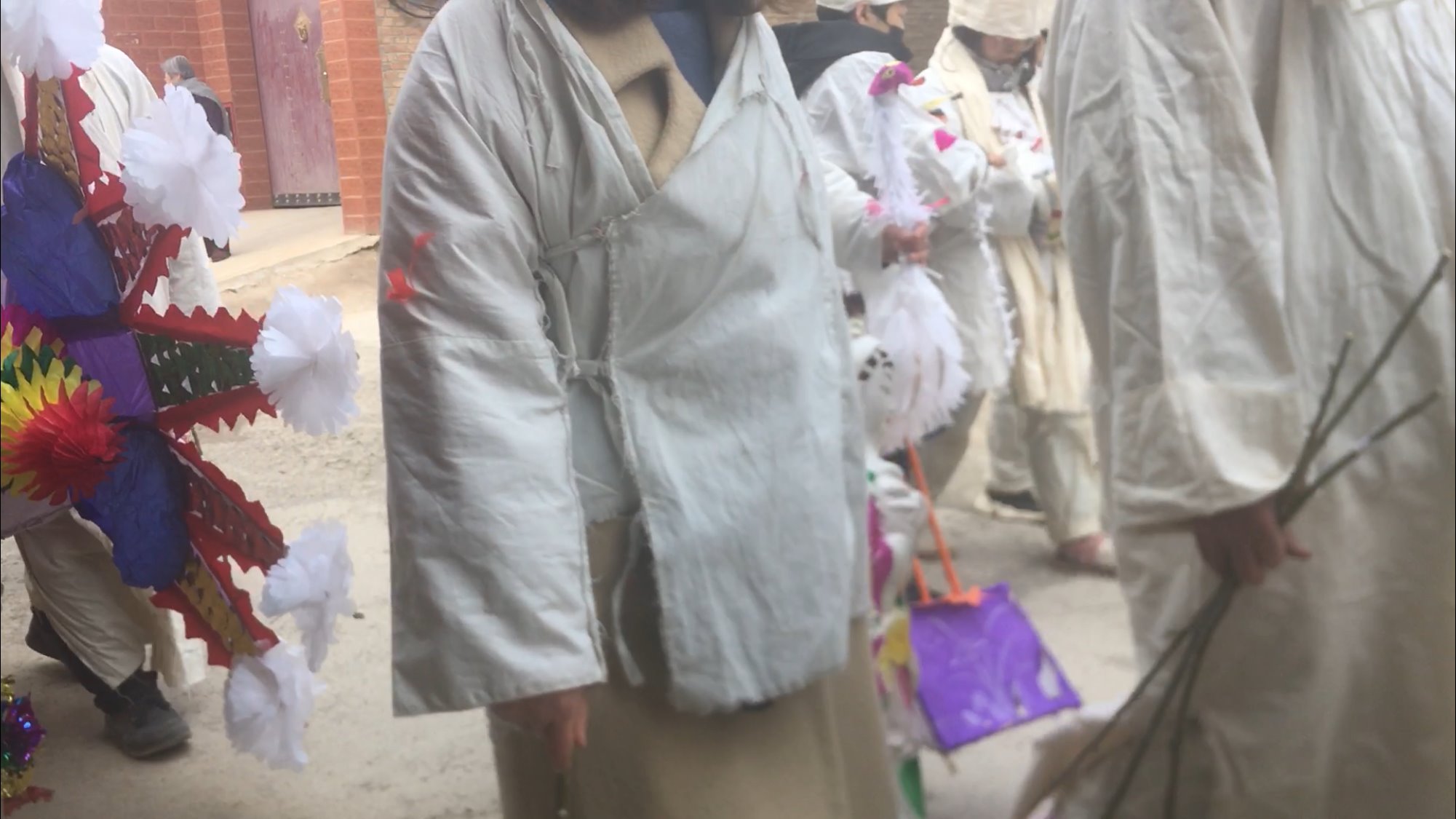
i went to a funeral today in my village with a cousin. she is his relative and died in hunger and coldness and illness two days ago at home. in her early 50s. the widow had spent months on bed alone, and was given a bun twice a day, later once a day, by her brother who is also poor and unable to do more. a few months ago, she almost died in a similar situation, but survived to the surprise of everyone. some villagers said given her situation, death is finally an end of her suffering and perhaps it is better this way. some said she had a soft temper. some said she was lazy and slow. some said she suffered from alzheimer’s along with mental issues.
three years ago, her husband went to a government office in the city with two boxes of apples as gift to apply for state benefits. on his way back home he fell to the ground. he was taken to hospital and doctors said it was hemorrhagic stroke and asked for RMB 5,000 to do the surgery. relatives were called one after another. it was only late at night when one relative finally showed up ready to pay. doctors did a CT scan and found his brain was already flooded with too much blood to do anything. he died.
the couple had been living in an old yard with no walls, full of overgrown weeds, and basically only one room with a bed. they had adopted a daughter from her sister from another village when the girl was around ten. but they were not able to pay her education and living costs and her sister paid. later her sister cannot afford either and the girl dropped out and went to work in the city. they devoted much love to the daughter but she felt ashamed of their poverty and hoped to have nothing to do with them. the daughter went back to her biological family and did not care very much for them. so today is certainly the last time she is in this village. it is also the end of a whole household, a family.
my cousin said the way poverty was “eliminated” here is often by cancelling the recipients’ poverty status in documents, which results in recipients receiving even less benefits. some villagers said in these two years the government offered subsidies for electric heaters so that many households had bought and installed it for just 200 yuan, including this household. previously villagers used coal, which became illegal in recent years for environmental reasons. but many families find the electric bill too expensive and rarely use it in winter, including the two old relatives i visited today who did not even know where is the on/off button.
the funeral was simple, not heavy, and cost only a few thousand yuan. my cousin, along with another relative, left before the procession took the coffin to the field for burial, partly because they were busy and partly because they knew the meal provided at the end of the funeral, which is the local custom, would not be a feast and probably wouldn’t even contain any dish with meat.
— posted with permission from an original text by Pop,
2020年12月17日,早上07:55
|
.
|
rss 2.0 | feedburner | del.icio.us |
|
.
|
this work is licensed under a Creative Commons Attribution-Noncommercial-Share Alike 3.0 License. |
|
.
|
site by orange 程康 and ourwork.is. |
|
.
|
best viewed with your character encoding set to unicode utf-8. |
