i flew again on your birthday. that’s the excuse anyhow, for these weeks of greetingless-ness. but noticing that this makes for too many times of beginning with ‘sorry’ when the greeting finally comes, i don’t want to say sorry yet again——know i’ve already sucked the meaning of words dry these last years. too much has already been said, or if i did say it, something always warps and buckles along the way. bristles bend. it never feels right, and i detest this rightness. words overlap and cancel one another like low-res animations playing endlessly in an empty, unlit room.
actually it is now the third year in a row to be on an airplane on your birthday, perhaps the mark of a ritual. to be in air as excuse, to be full of air as metaphor, to be on flight mode as break of communication. to catch so much of your own breath there is no longer space for words. being in an airplane is kind of like that, anyhow, the quiet of disquiet, white noise turns pink turns brown, ears turn inwards.
perhaps rituals serve the same purpose: affirmations of meaning that do not really require words. small gestures repeated at certain intervals of time create affective knowledge, like knowing the amount of time before the sun’s blessings make Alÿsian-sized valleys of industrial blocks of ice. the valley of all that i could have said but did not spilled over the sides of the building, he sent American Greetings e-cards once a year, there was a click over a caress. she would rather say nothing at all than let it be said cheaply.
a no-rhythm rhythm. that’s the ritual. flight mode white-pink-brown noise, repetition, air-pressurised tinnitus, the rituals of getting older. i miss you sometimes and that is all. there is not much more efficacious beyond that. i really hope that you are happy, that your body fills with good air and songs of peace. the fact that i can no longer tell otherwise is perhaps the sign that there was no more space for me to know——air time——like the sound of a stranger’s breathing next to you on a long distance journey. it feels close because everything around is passing darkness, and you’re too timid to ask any more questions because you were once cursed for it. and because the best regard answers in words never bring you anywhere.
better to take a flight instead.
happy birthday and a new year, f
Posted by 丫 | more »
沒有記憶的éŽåŽ» the first episode is goodbye
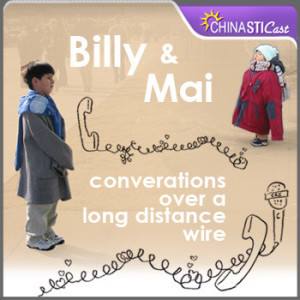
🐢 點iwishicoulddescribeittoyoubetter發起的時候åƒèˆ‡è€…haxi,今天GOODBYEéŽåŽ»æ™‚考å¤é‚„能挖出來這樣的一個回憶 💓ï¼05年在北京我第一份工作是給國際廣æ’é›»å°åšä¸€ç³»åˆ—英文æ’客。åƒhaxi所說的,「在preå¾®åšã€pre微信ã€pre移动互è”网时代,我们还åšè¿‡è¿™æ ·ä¸€ä¸ªä¸œä¸œã€‚[😎旺柴😎] ã€miss erminia,我電腦上有第16期,很想è½ä¸€ä¸‹ã€Œ💩 OHMYGAWD, I STEPPED IN POO 💩ã€é‚£æœŸï¼Œä½ 有嗎?⋯⋯OHMYGAWD 🎶 GOODBYE 2021ï¼Œæƒ³ä½ å€‘å‘€ï½ž
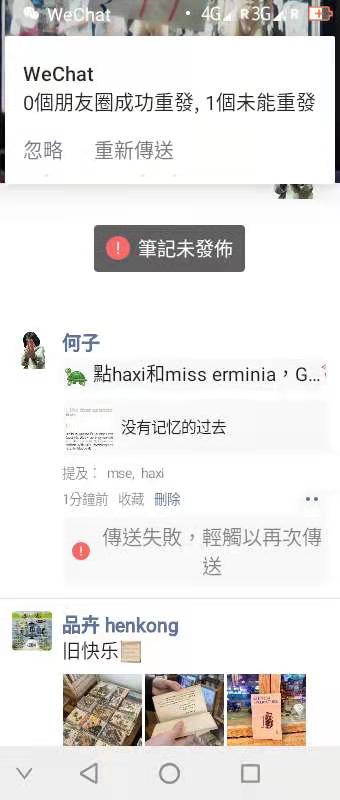
the news makes me cry every morning
2021 July 01, Hong Kong
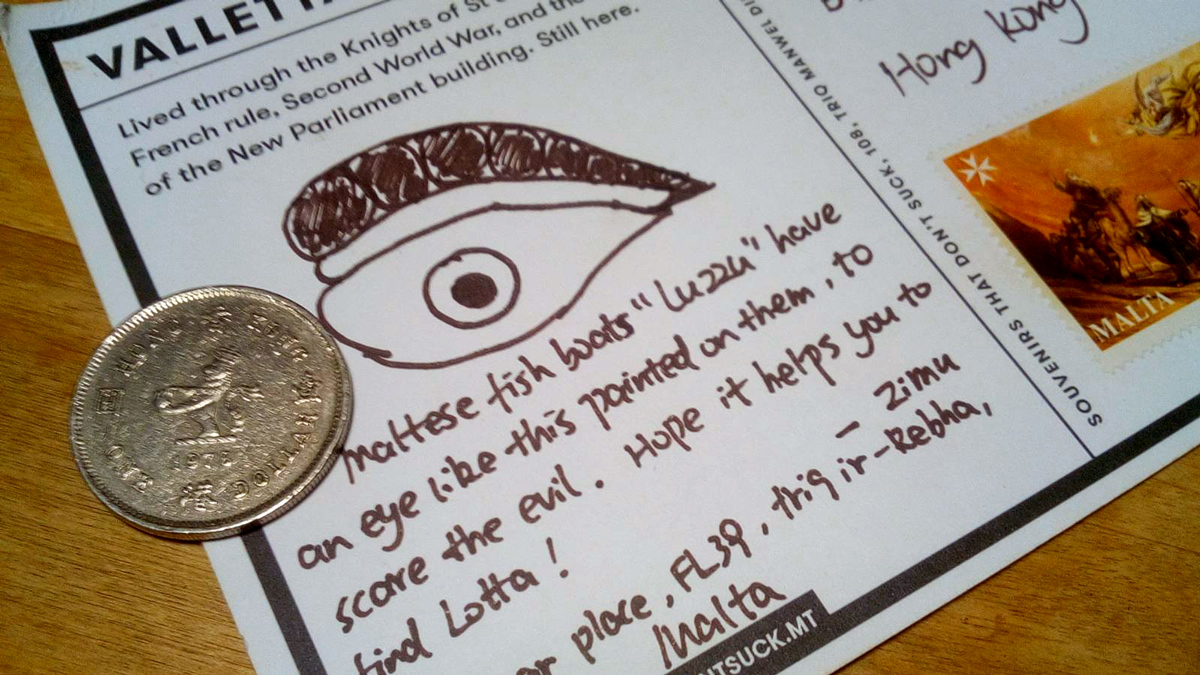
我剛剛下去樓下去買一ç½å•¤é…’「慶ç¥ã€ä»Šå¤©çš„節日,在Circle K被找錢,發ç¾å…¶ä¸åŒ…括了一塊1978年女英皇é 硬幣。回到我樓大廳,發ç¾éƒµç®±è£¡æœ‰å¦³å¯„éŽä¾†çš„明信片,上é¢å¯«è‘—「Still hereã€.
I just went downstairs to buy a beer to ‘celebrate’ the holiday today, and upon being given change at the Circle K, discovered amidst the coins one Queen Elizabeth head dollar dated from 1978. Returning back to my building, inside the post box was a postcard from you with a drawn eye of horus and the words, ‘Still here‘.
Posted by 丫 | reply »
但願您也在這裡 (finding greetings series no. 4)
ç´ç´„ New York – 蘇黎世 Zürich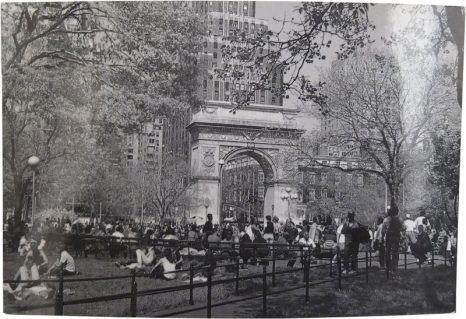
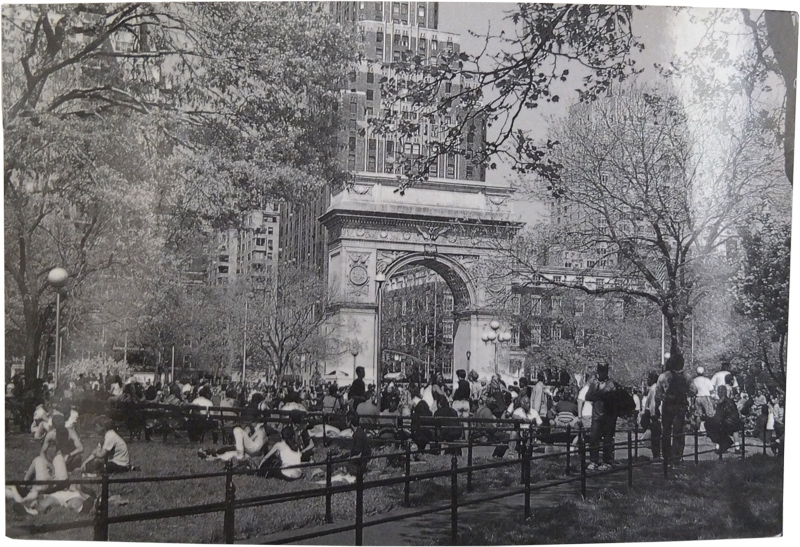
Washington Square Park
Photo: Battman
Piece of the Rainbow
©1993 New York
北伊羅戈çœä¸æ ¼æ‹‰æ–¯ Dingras, Ilocos Norte – æ–œå¡æ‘ Incline Village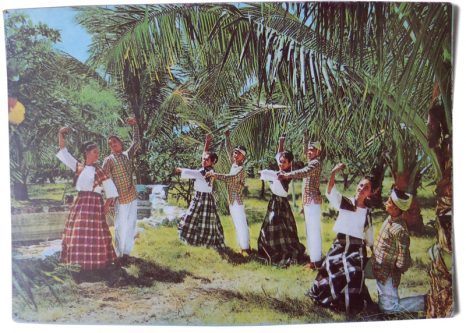
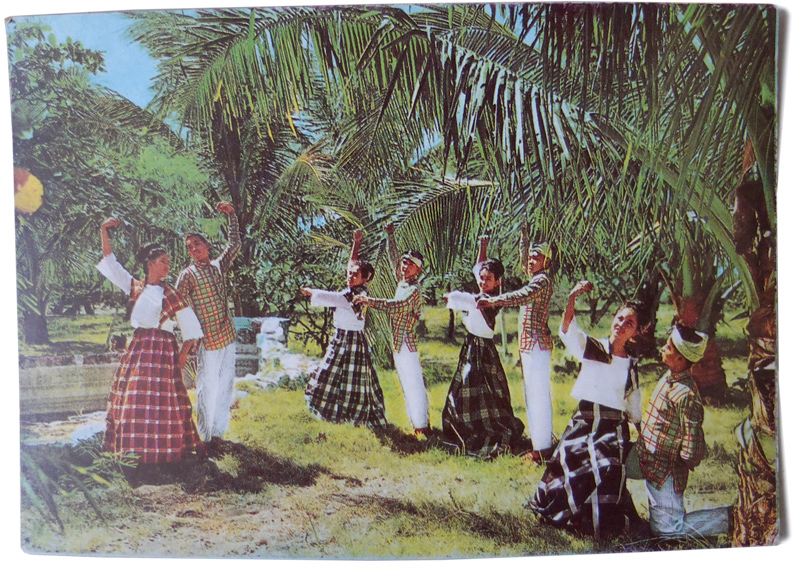
Ilocana a Nasudi
A dance of the Manongs and the Manangs, elder couple known for their religiousness.
Courtesy of: Barangay Folk Dance Troupe
Philippine Normal College
å¥§å…‹è˜ Oakland – 首爾 Seoul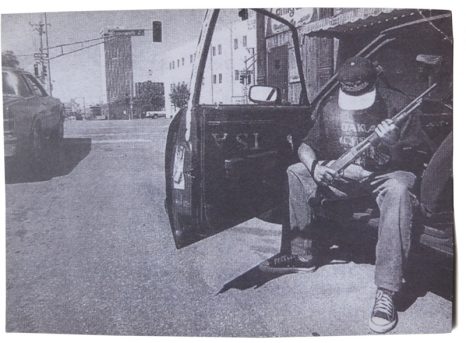
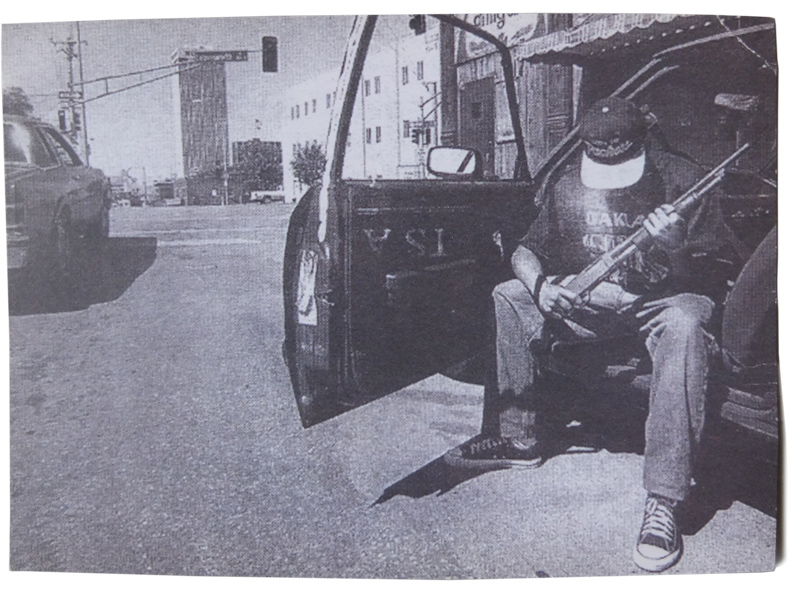
Alberto Chou
索倫托 sorrento – æ–°åŠ å¡ singapore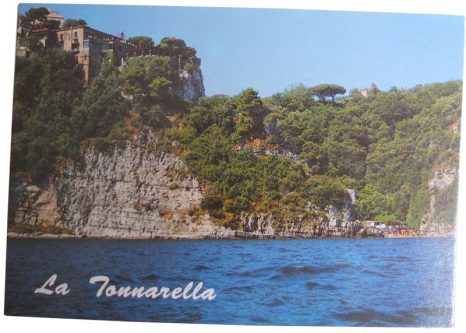
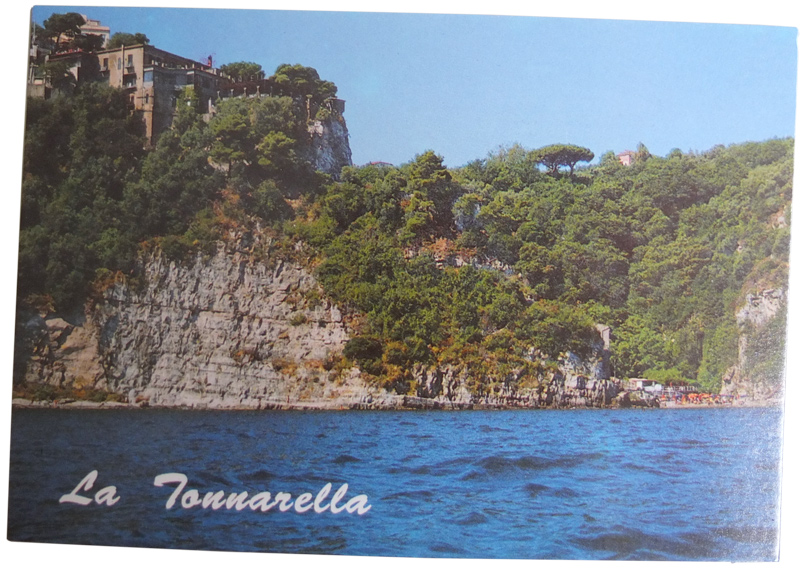
Pensione Ristorante La Tonnarella
Casella Postale 22 – Via Capo, 31
Tel. 081/8781153 Fax 081/8782169
80067 Sorrento
this set was posted March 2020, three-quarters known to be successfully received, though one never realised as it was intended. i guess it’s still in singapore and you’ve moved on to taipei now, busy with digital things. then there’s one from you on the way, though i’ve also moved on, around the corner of the sea since then, and it will be a while before that post box can be checked. it’s the same post box that you sent your painting to, the one that was too small for the painting so the delivery person had used long rubber bands to strap it to the face of the box. you wished you had seen what that looked like when i told you about it, but unfortunately i had forgotten to take a photo. your painting is now framed and hanging at an odd angle from a pipe above my kitchen.
recently during a bonding session about mutual compulsive collecting habits, i told p about how i pilfer the werbung from other post boxes in my building, the unsolicited pieces that have nice plastic packaging that i can reuse to wrap other things. Once there was also a sticker advertising plumbing services, i have quite a few of them now. Very pretty.
it’s no surprise that all these things material and immaterial circle around one another like cyborgs and spirituality. he calls it the ‘eternal network‘. Looking again now from the current perspective of lonely immobility it feels sadly less anticipatory but only maudlin, a ‘radical inclusionism’ that makes most bored and need to leave the room. self-descriptive at best.
Posted by 丫 | reply »i saw the End of the Century
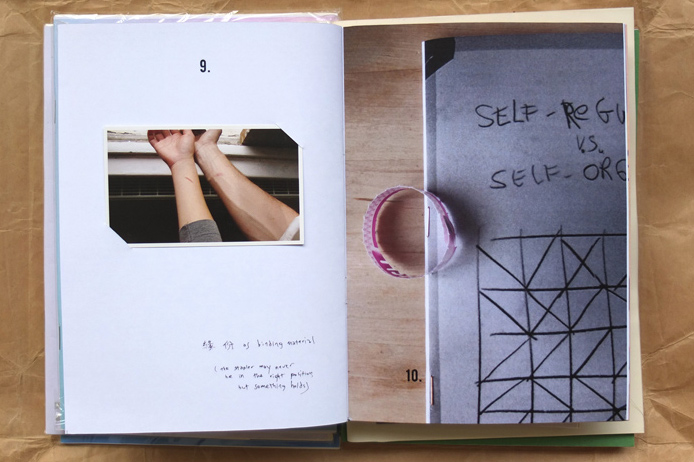 L and E with matching scar tissue, Arnhem 2001
hallo, dear L,
Now that the cinemas have finally shut down (they tried their best to hold out as long as they could, seating only available in every other row), I could finally watch the end of the century go. And even if ever so subtle, it washed over me like the laps of a past self that had been thrown overboard so long ago, now cuddling up uncannily like the sound of the sea in a new moon darkness. Yes, as she said, “the way sounds, music, make you remember things you’d forgotten about yourself“.
I remember when you
(and everybody)
first got into skinny jeans,
but did you notice
that I was a bit deprecating about it?
It’s that self of we when we were more intertwined, so perennially you (is me, in admiration, is we, growing up together), and yet now grown into other realms. a wise father, still awkward (some of the cuts), still funny (still innocent), but more nuanced perhaps. It’s learning to speak from experience rather than in the voice of those we admire, just like you said. It is you, so perennially, ever you (they even look like yous), so much that i know you’ll laugh with me when i say that is a very gay man thing to do. Right around the end of the century you told me how you knew you were gay, and I can tell you from my woman’s experience that things on this end were not so straightforward, but that is me, and yous is yous. Those selves are another perception of time in a knowing-queer way, perhaps, and even so we can still be full of references (Buñuel, the assured knowledge of self in movement, so many conversations recalled, and a Barcelona to Linklater’s Vienna) because those are our experiences, too.
Amidst those fleeting points of reflective light that glimmer ever so often amidst now isolation, I was reminded to speak from a place of wisdom. Not to assume wisdom, but yes, to recall, revisit and retranslate those places we’ve been, the conversations we’ve had, and the feelings that have always been facts. Life, as she said (that someone else said), is less like the sturdy tree and much more like the weather. And fickle as that may be, we know beyond everything the colours of sunset and ensuing fall of temperature, the scent of rain, and those broad, striped gusts that ping the ear and make us hold tighter. That’s all there is. Weather, and wisdom. So let’s hold tight, as far away as we may be.
and on continuity:
a box-o’!
just slightly disappointed that it was
obviously empty—
javi drinking the last drop
repeatedly,
and ocho hesitantly taking it
still half full…
(or personality references?)
___
Fin de Siglo, now viewable online via Lucio Castro and/or a few links when you look for them.
Posted by 丫 | more »
Textual Notes PWSSSRFS…
(there are reasons to think about my body and hygiene these days)
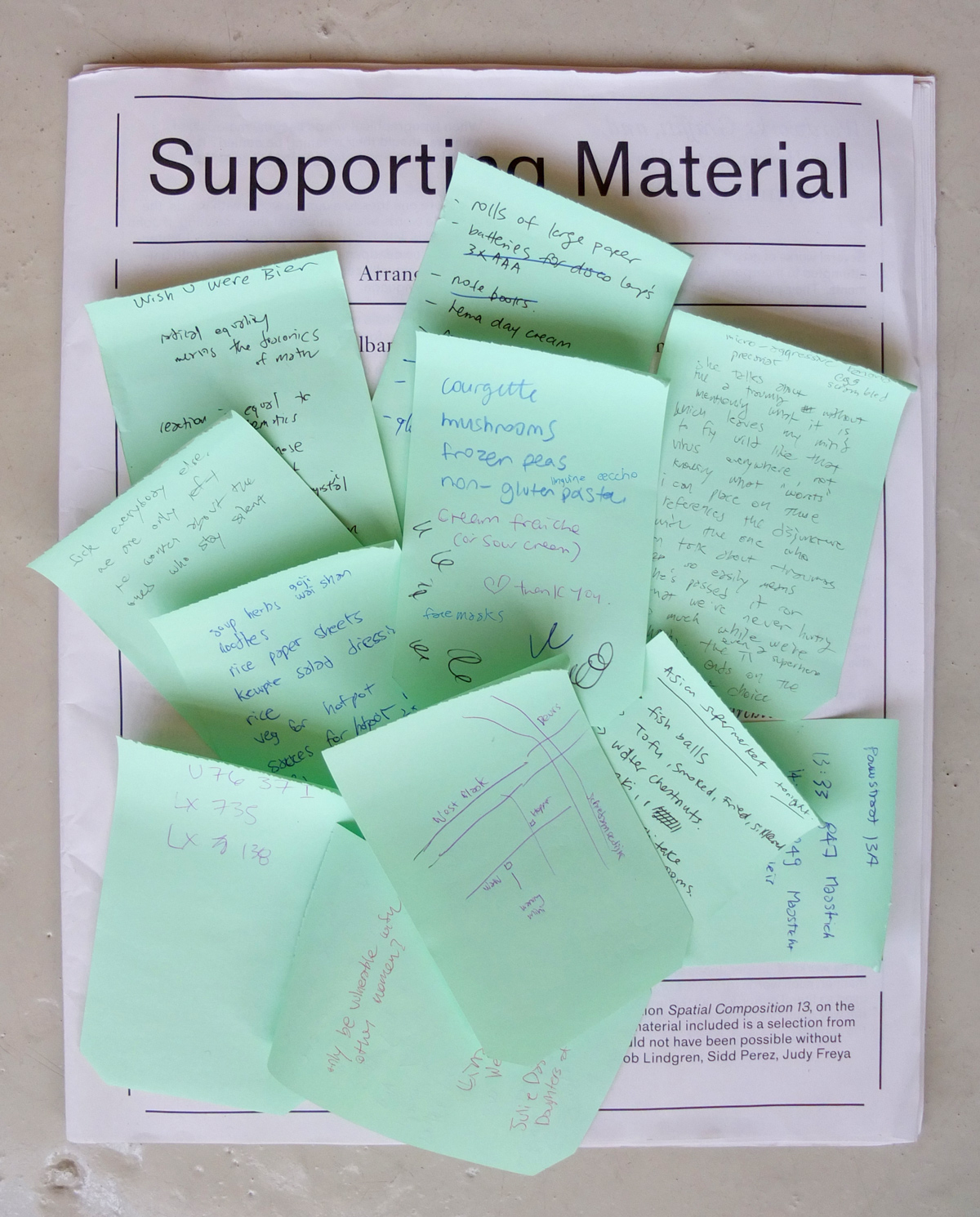
— Notes taken while on residency with Amy Suo WU at Motel Spatie; Arnhem Presikhaaf, 2020 January-February
In the time of that sojourn, a surface wound that stayed the entire time, irritated, flaming and hardened so much that it was narrated from being the oddity of a pimple on my hand to the paranoia of a wart-like abscess. It accompanied me during our conversations like a replacement for the biting of nails which had accompanied me since childhood, the extra psychosomatic conversation with myself to harmonise and discord with any other conversations going on in the room. And we spoke about intersectionality.
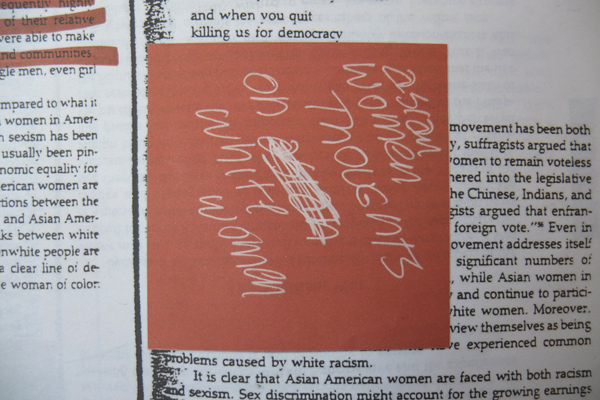
— from “Worlds in Collision: Multicultural Art History (Selection)” by Carlos VILLA, from Supporting Material by Celine CONDORELLI
I picked at it, making it bleed and scab over more than once, wondering if this would be the lifelong marker with which to remember this time. Other people get tattoos for such occasions, but somehow for me bruises, scars and mosquito bites were always enough. Sometimes I liked to think about the tiniest bit of spittle from an insect you never saw being smuggled transnationally, at peak seasons such that your body could carry two nationalities of mosquito saliva at the same time, recognisably different by the radius of red and degree of itch.
It was only a surface. But as my skin-scoring became manic, I remembered one of the first meals we shared together, when we were happy to find a few pairs of disposable chopsticks in the otherwise fork-and-knife-loaded space. A bit too brashly did I rip apart the two sticks and rub their ends together so as to smooth the rough edges in the way that we had learned, and somehow a little bamboo splinter had lodged itself into the meat between the thumb and forefinger of my right hand. This is the pressure point you are supposed to massage in order to release anxieties, and so it was that this residency——initially planned as an artistic labour——unfolded into my body subversively with a small army of histamines hardening a point known as åˆè°· hégÅ, or LI-4. Like a pain to help release pain.
I had been telling everyone that it had been such a difficult year for me, or for most people in my context, rather, but now, when I had limited this sabbatical purposefully to run back into the fire, that heat seemed to flake away into something much more quietly insurrectionary, like the last hibernation before the end of the world. What were we gathering amidst these stories and meetings, me picking self-consciously at a surface wound on the back of my hand and scheming in those vague ways afforded by poetry? Would it be possible to be productive about this care in letting go, somewhere in between concern and a manic extraction of the conversation one has with oneself, parasiting off of the glimmers of knowledge and joy and jealousy of these people around me. So many intensities.
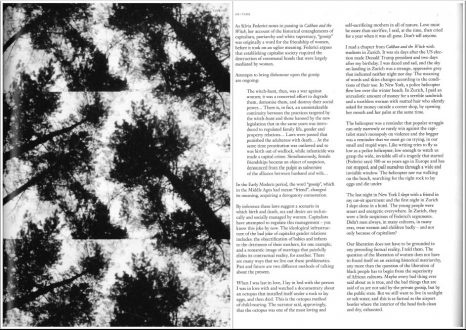
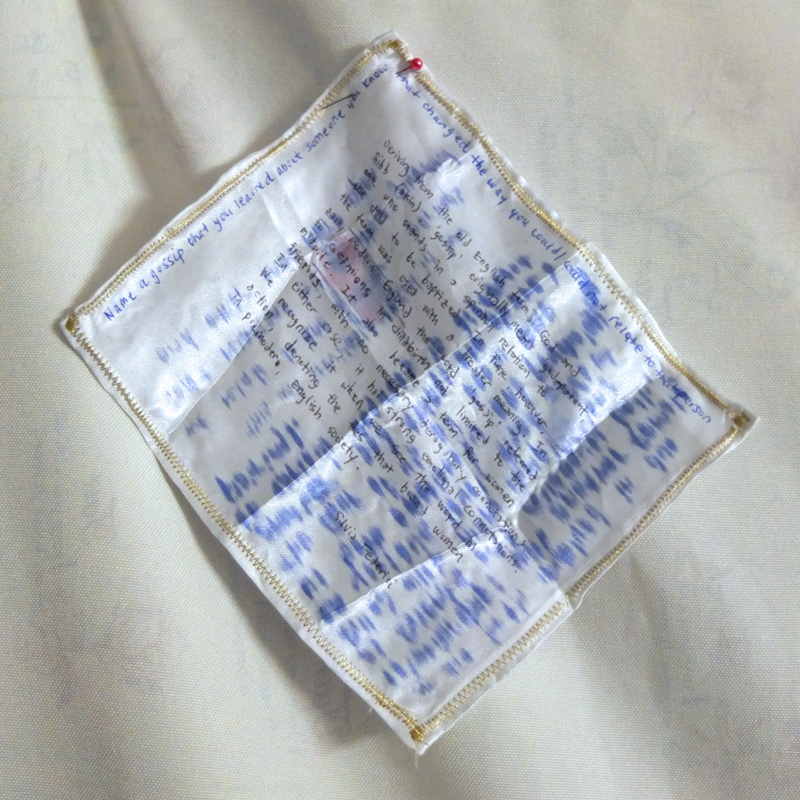
— “Witch-hunt: gossip has always been a secret language of friendship and resistance between women”, Hannah BLACK
In many parts of the world, women have historically been seen as the weaver of memory——those who keep alive the voices of the past and the histories of the communities, who transmit them to the future generations and, in so doing, create a collective identity and profound sense of cohesion. There are also those who hand down acquired knowledges and wisdoms——concerning medical remedies, the problems of the heart, and the understanding of human behaviour, starting with that of men. Labelling all this production of knowledge ‘gossip’ is part of the degradation of women——it is a continuation of the demonologist’s construction of the stereotypical women as prone to malignity, envious of other people’s wealth and power, and ready to lend an ear to the Devil. It is in this way that women have been silenced and to this day excluded from many places where decisions are taken, deprived of the possibility of defining their own experiences, and forced to cope with men’s misogynous or ldealised portraits of them. But we are regaining our knowledge. As a woman recently put it in a meeting on the meaning of witchcraft, the magic is: “We know that we know”.
— Witches, Witching-hunting and Women, Silvia FEDERICI
Among you, it becomes difficult to compare all that has been said to all that has not been said. All of these conversations. And these words are a conversation with those conversations, if not simply out of a question of translation but out of the need to make space for myself in this constellation of you(s) and me(s). To ascertain, like that book I took from your bookshelf: Feelings are Facts. We(s) would need to meditate through hours and hours of these discourses in order to sift though the medley of feelings that make up this moment, and that is a fact, too. Yes, as the witches say, “We know that we know“.
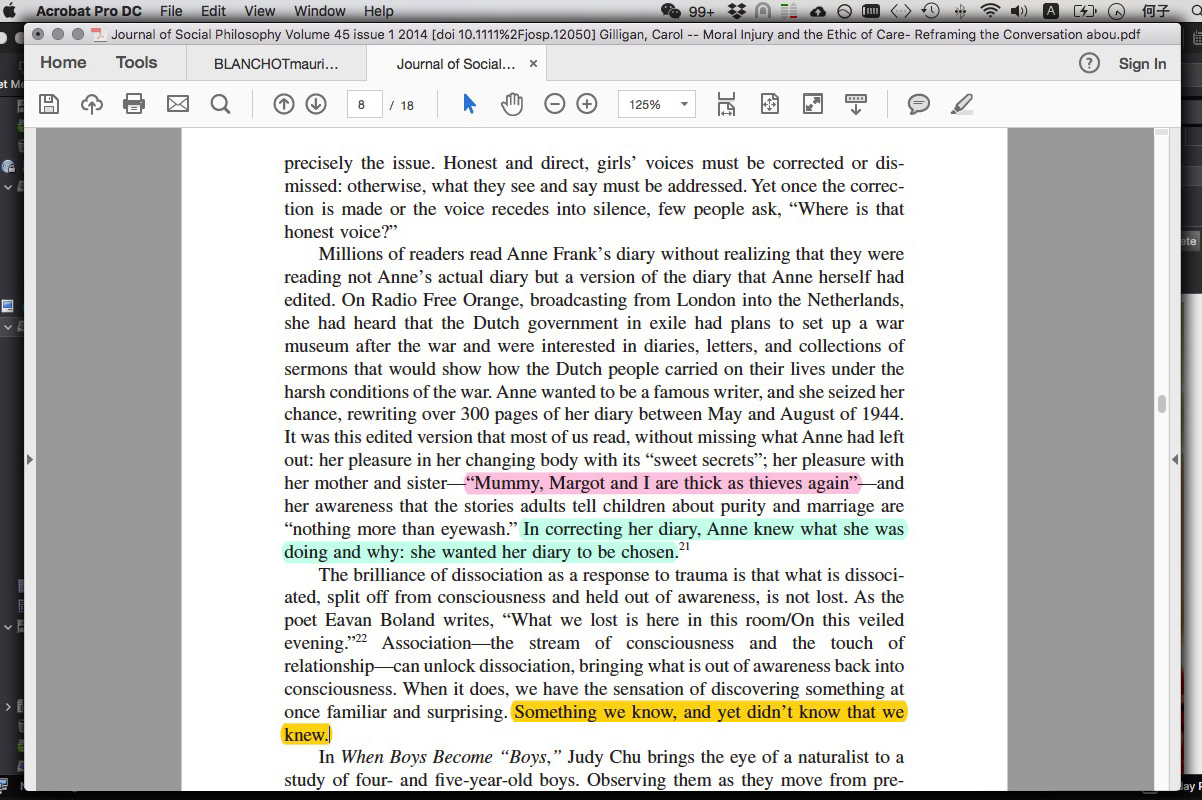
— “Moral Injury and the Ethic of Care: Reframing the Conversation about Differences”, Carol GILLIGAN
And maybe I know too many things. My head is filled with all sorts of banalities like the facial expressions of strangers and the taste of your favourite Grüner Veltliner and the prick of winter mosquitoes. Like the approximate sojourn of a piece of shit that appeared a few days after I arrived. It was the lack of anyone’s care to remove it from the narrow path between our residency room and the project space, making it such that you took the long route around every time, while I forged ahead to play hopscotch. I had the forethought that this dog I never saw had left the natural wastes of its circulating body just like the mosquitoes, and perhaps I should bring other contraband back this time as another memento of my stay. But an uncared-for poop was just a parallel temporary visitor like us to this space motel, and the day before I departed, what were now like hardened coal nubs finally blew away with that strange storm of not very much rain. Perhaps its winds were so great it blew its own rain away, a storm having a frightening conversation with itself. Its utterances came out like screeches and gales that shook the glass of our cove. From inside, we lifted our heads up in awe, and when we went outside we walked at strange angles with our heads down, pretending not to overhear. Buddha was also blown violently away that day, falling off of a neighbour’s balcony and left as an Asian corpse shattered in the white neighbourhood. In the beginning I kept thinking we would have been a strange sight here, our little crew, but actually there was nobody around most of the time, and we were left to play on our own like children at the slumber party. We stole time that way, turning their money and our own productivity into a space for taking care. Even so, I walked on that shit at least once, but you took time, and we cleaned up our tracks together. Self-quarantine, if you want to call it——I gained ten kilogrammes, too——but something else feels lighter because I know we had taken it on together. This takes space and so it was that ‘project ruimte’ was exactly that, not as the space for projects but a project to make space, as a fact of feelings between us——to read together with long pauses in between, to write letters from near and far, and to eat and resist the fallen communality of a shared meal out of one bowl. To be together and trust in someone else’s voice to guide when our eyes are closed.
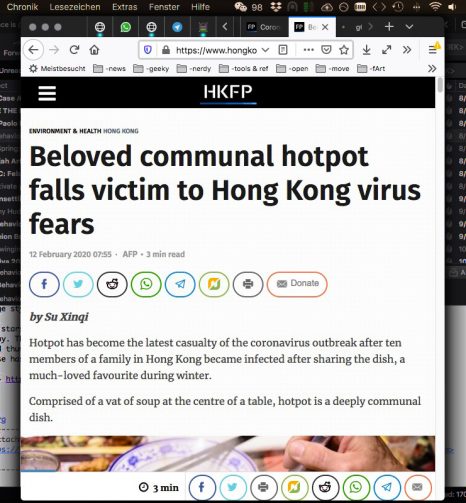
I don’t know yet how to bring this space into visibility. And maybe it doesn’t have to, except as mischievous glances and giggles between those of us who know, and even if you don’t see us you will feel the smiles in our voices in that space behind your ears and in front of your neck——a tingling somewhere between an itch and a tickle to make chords and discords in you, too. Take care.
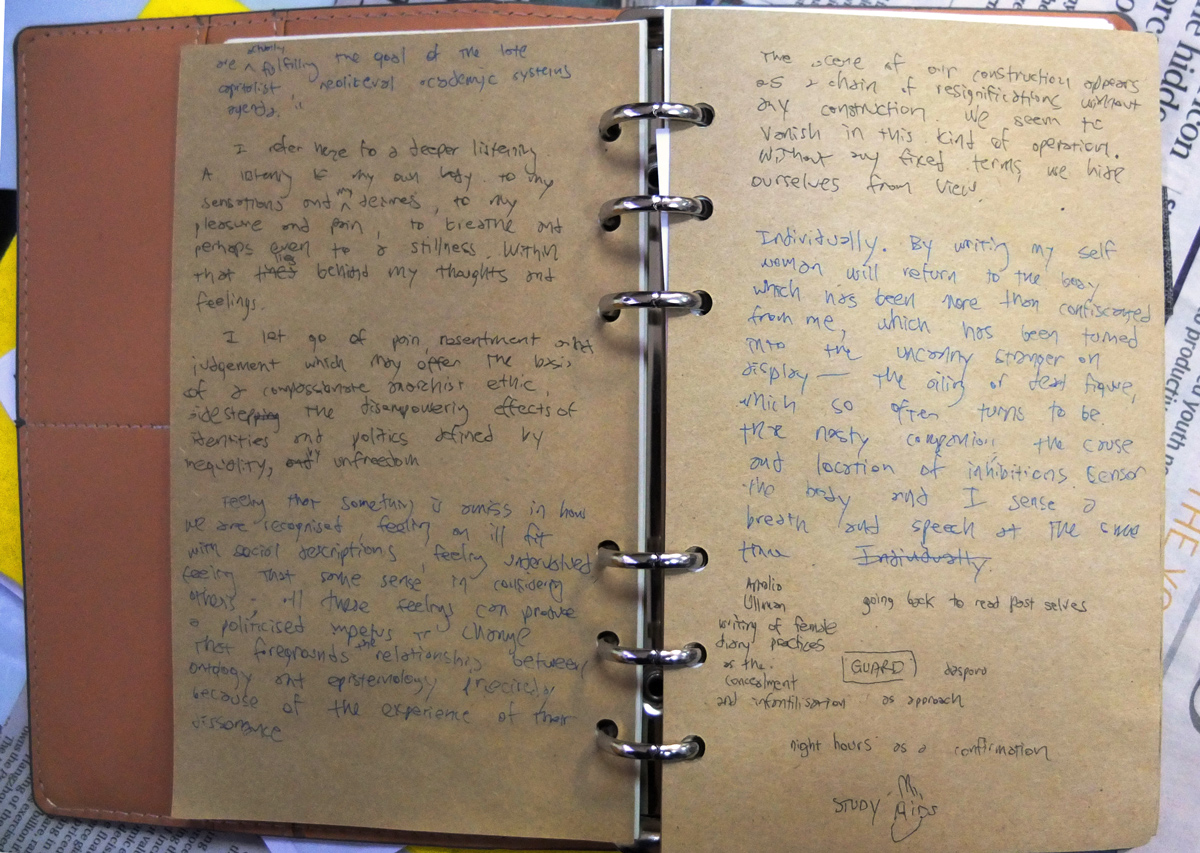
— Altered quotations and notes taken from the afwasdoekje reading group, PWSSSRFS No. 1, 2020 January 25
elephants in the middle of nowhere
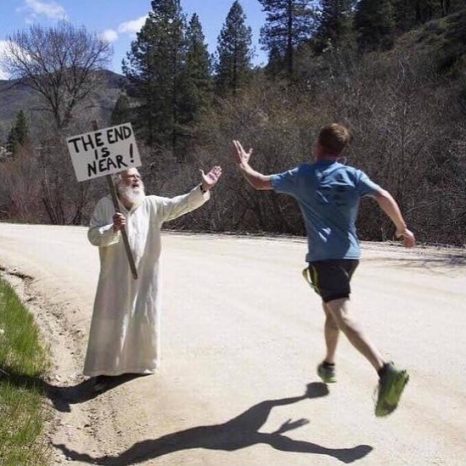
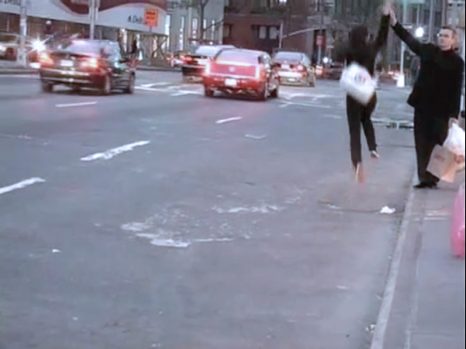
we keep missing that catch-up conversation, but “your absence fills the space”, and i’ll keep running. congratulations, dear s… until the next high-five.
left // internet, right // ç†å˜å¥æ›² Variations on LÇ (New York, 2006)
Posted by 丫 | reply »â€œi still don’t think it is the good timing to talk about some personal matters during the war, but the war seems will last for a long time.â€
i always think of you when i write. you.
to you.
you.
you.
you wish it was you, rather than just any old you, because that generic intimacy gets so tiring after awhile, or it’s what got you into trouble, a tiny, unnoticeable violence that you never realised would accumulate after so much time into that giant, violent thing that fell spilling on to the ground today (å–‚ï¼ä½ è·Œä½è‰¯å¿ƒå•Šï¼).
a dichotomy of distance, ‘cuttings on the shop floor‘. it was me, as i wrote to a generic you (apparently called ‘vanilla’) that never understood how to distinguish between a friend, an accomplice, an acquaintance, someone we should have not wasted so much time on in the first place. on that side of the ocean they always laughed about it, quotation-marks-friend-quotation-marks filling the air in a disdainful, joking way.
yeah… it’s a loose term perhaps. look what’s happened to us. purple on one side, green on the other, jokes, the joker, shiso leaves.
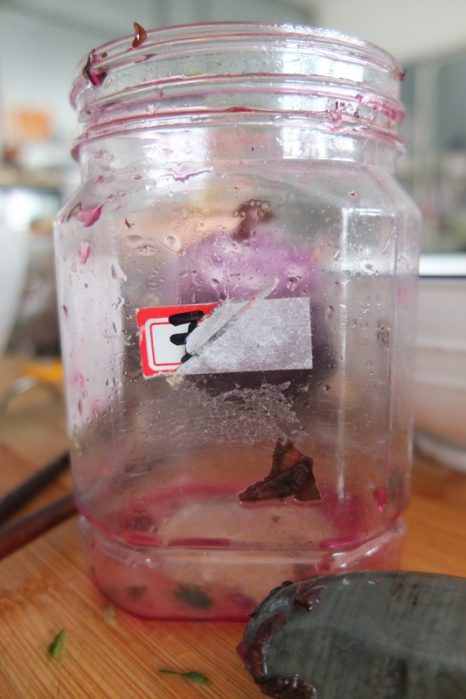
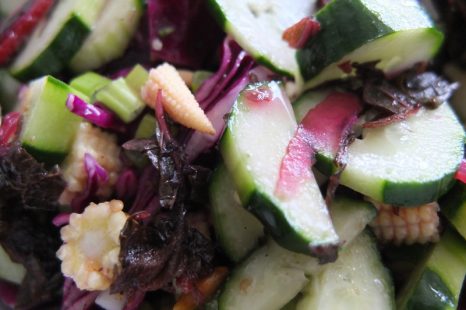
i finally finished that jar of pickled shiso that K had made me, long after he had gone. guess we are all supposed to hate him now, just disappearing like that, but the shiso was so tasty and he had been so sweet and eager to make it for me before i left that day, i couldn’t help but hold a soft spot for him. it turned out to be the last time we would see one another.
at the time he was like a boy and a master, chopping the leaves finely with that sort of precision that always made you think of Q’s story about the butcher and é“ the tà o. K proudly handed me the square plastic jar labelled with a little sticker bearing his name on it, instructing that if i had a stone i could clean it and put it in the jar as well; pressing down the leaves enhances the flavour. in the end the juice can be used also, so there, in the end, i poured out the last drops of bright pink pickling sap onto a bright purple and green salad, and together they made me think of the colour of an aura (you). A possible colour which i had never been able to see before myself but had been described to me by that blonde couple staring wide-eyed, many years ago, at some tinted space just a bit off from direct eye contact, in that way that some blind people do.
maybe my aura had bled out. fled, as sure-footed as he was when he left her, and now he’s off in some Wong Kar Wai movie, the one that’s tinted a muted aqua-grey colour, with lots of stony blues pressing down to enhance the flavour. he unhooked himself from her; she is pregnant and going to marry all of her ‘friends’ instead. but how do we unhook ourselves from ourselves? that bright purplish-pink is gone and filled only with the headache of being awake.
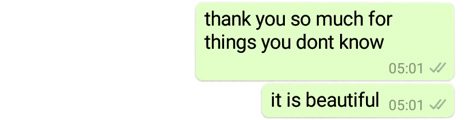
do you remember when we talked about being woke? what a funny presumption, don’t you think? i feel more ‘awake’ than ever before, and it’s shitty to not be able to sleep even if it increases the number of episodes for ‘things i don’t know‘ playing on repeat. the same same collapses in upon itself.
later, she wrote: ‘Stay fiery. I went to a Naomi Klein talk with sheets Thunberg last night and she reminded us the way to fight fire is with fire. 🔥 ‘
but the same same collapses in upon itself. it is just so hard to stay fiery. these weekends going out there, out there, around and behind and on the margins of front, the smell, these acculturations that kill me. weekend weekend, monday to friday. it had dawned upon me, after the summer of discontent, that the problem right now is that all that practice that i had built a practice upon didn’t make sense anymore. like i used to dislike contractions, and now they’re here all over the place, sense changes. is she more awake now, now that she is pregnant and he’s gone off to the Philippines? Where is that collusion between all those baby details we once found god in, and, baby mama, this big shit of a mess we’re in now?
Posted by 丫 | reply »|
.
|
rss 2.0 | feedburner | del.icio.us |
|
.
|
this work is licensed under a Creative Commons Attribution-Noncommercial-Share Alike 3.0 License. |
|
.
|
site by orange 程康 and ourwork.is. |
|
.
|
best viewed with your character encoding set to unicode utf-8. |
